
- INTRODUCTION:
“Every contract begins with an agreement, but not every agreement becomes a contract.”
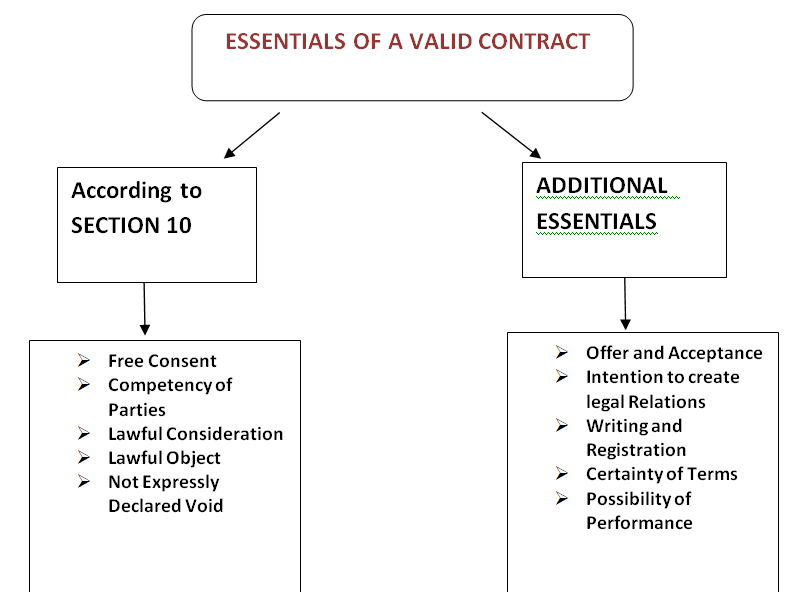
This principle, derived from Section 10 of the Contract Act, 1872, and reflected in Anson’s Law of Contract (28th Edition, p. 1), highlights the fundamental distinction between an agreement and a contract. A contract is the cornerstone of all commercial and social relationships in a civilized society. It provides a legal framework within which individuals and entities may create rights and obligations enforceable by law. While every contract originates in an agreement, not every agreement satisfies the legal requirements necessary to become a binding contract. The distinction lies in the essential elements prescribed by law. Under Section 10 of the Contract Act, 1872, only those agreements that meet certain statutory essentials free consent, competency of parties, lawful consideration, lawful object, and not being expressly declared void are recognized as valid and enforceable contracts.
2. STATUTORY PROVISION:
According to Section 10 of the Contract Act, 1872:
“All agreements are contracts if they are made by the free consent of parties competent to contract, for a lawful consideration and with a lawful object, and are not hereby expressly declared to be void.”
It means that only those agreements which satisfy the essential elements laid down in Section 10 attain the status of a contract. These essentials are as follows:
3. DIAGRAMMATIC ILLUSTRATION:
4. ESSENTIALS OF A VALID CONTRACT:
I. Free Consent: For a valid contract, the consent of the parties must be free.
According to Section 13,
“Two or more persons are said to consent when they agree upon the same thing in the same sense.”
According to Section 14, consent is free when it is not obtained by:
i. Coercion;
ii. Undue influence;
iii. Fraud;
iv. Misrepresentation; or
v. Mistake.
Illustration:
X compels Y at gunpoint to sign a contract. This is not a valid contract because consent was not free.
II. Competency of Parties: According to Section 11 of the Contract Act, 1872, parties are competent to contract if they:
i. Are of the age of majority;
ii. Are of sound mind; and
iii. Are not disqualified from contracting by any law to which they are subject.
Illustration:
G, a person of unsound mind, agrees to sell his car to H for Rs. 200,000. This is not a valid contract, as G is not competent to contract.
III. Lawful Consideration: Consideration means something in return. An agreement is enforceable only when both parties give and receive something of value.
According to Section 23 of the Contract Act, 1872, consideration is lawful if it is not:
i. Forbidden by law;
ii. Fraudulent;
iii. Immoral;
iv. Opposed to public policy;
v. Defeats the provisions of any law; or
vi. Involves injury to the person or property of another.
Illustration:
A promises to obtain a government job for B, and B promises to pay A Rs. 50,000. This agreement is void because the consideration is unlawful.
IV. LAWFUL OBJECT: The object of an agreement refers to its purpose or ultimate aim. If the object is unlawful, the agreement is void, even if the consideration is valid.
According to Section 23, an object is lawful if it is not:
i. Forbidden by law;
ii. Fraudulent;
iii. Immoral;
iv. Opposed to public policy;
v. Defeats the provisions of any law; or
vi. Involves injury to person or property.
Illustration:
A agrees to pay B Rs. 10,000 if B assaults C. The agreement is illegal, as the object is unlawful.
V. NOT EXPRESSLY DECLARED VOID: An agreement must not be one that is expressly declared void by the Contract Act.
Examples include:
- Agreements in restraint of trade;
- Agreements in restraint of marriage;
- Agreements in restraint of legal proceedings;
- Wagering agreements;
- Agreements that are uncertain or impossible to perform.
Illustration:
A promises to pay B Rs. 5,000 if B closes his business. This agreement is void, as it is in restraint of trade.
5. Additional Essentials:
VI. OFFER AND ACCEPTANCE: For an agreement, there must be a lawful offer by one party and a lawful acceptance of that offer by the other. The term lawful implies that the offer and acceptance must satisfy the requirements of the Contract Act.
Illustration:
A says to B that he will sell his bicycle to him for Rs. 2,000. This is an offer. If B accepts, there is an acceptance, resulting in an agreement.
VII. INTENTION TO CREATE LEGAL RELATIONS: The parties to an agreement must intend to create a legal relationship. Agreements of a social or domestic nature do not create legal relations and thus cannot give rise to a contract.
In commercial agreements, however, it is presumed that the parties intend to create legal relations.
Illustrations:
- A invites B to his birthday party. B does not attend. A cannot enforce the agreement because it is a social agreement.
- P offers to sell his ring to Q for Rs. 8,000, and Q agrees. This is a contract.
VIII. WRITING AND REGISTRATION: A contract may be oral or written. However, if the law requires certain contracts to be in writing, signed, attested, or registered, those formalities must be complied with
Illustration:
A orally promises to sell his house to B. This is not a valid contract, as such agreements must be in writing and registered.
IX. CERTAINTY OF TERMS: According to Section 29,
“Agreements, the meaning of which is not certain or capable of being made certain, are void.”
The terms of the agreement must therefore be clear and definite.
Illustration:
A agrees to sell B “a hundred tons of oil.” Since the type of oil is not specified, the agreement is void for uncertainty.
X. POSSIBILITY OF PERFORMANCE: According to Section 56,
“An agreement to do an act impossible in itself is void.”
If an act is physically or legally impossible, the agreement cannot be enforced.
Illustration:
A agrees with B to fly using his arms. The contract is not enforceable, as it is impossible to perform.
6. CONCLUSION:
In essence, a contract is the lifeblood of legal and commercial dealings, transforming mutual promises into enforceable rights and obligations. Not every agreement achieves this status only those that fulfill the essential conditions of free consent, capacity, lawful consideration, lawful object, and absence of express invalidity, as prescribed by Section 10 of the Contract Act, 1872. These elements ensure fairness, legality, and certainty in every contractual relationship. A contract, therefore, is not merely a moral obligation but a legal bond recognized and upheld by law. As Sir Frederick Pollock aptly observed, “A contract is a promise or set of promises which the law will enforce.”
Leave a Reply