
1. Introduction:
The World Trade Organization primarily regulates international trade, but its legal framework also recognizes that trade liberalization must operate consistently with sustainable development and environmental protection. The Preamble to the Marrakesh Agreement expressly refers to sustainable development and the need to protect and preserve the environment. This objective has influenced the interpretation of WTO rules, particularly Article XX of GATT 1994, which permits certain measures for the protection of health and conservation of natural resources. WTO environmental jurisprudence therefore seeks to reconcile international trade with legitimate environmental objectives while preventing environmental measures from being used as disguised protectionism.
2. Integration of Trade and Environmental Protection:
A basic principle of sustainable development is that economic growth and environmental protection should not be treated as opposing objectives. WTO jurisprudence reflects this approach by recognizing that trade liberalization is not absolute. Under Article XX(b), members may adopt measures necessary to protect human, animal or plant life or health, while Article XX(g) permits measures relating to the conservation of exhaustible natural resources. At the same time, the Chapeau of Article XX prevents these exceptions from being applied arbitrarily or as disguised restrictions on international trade. Thus, WTO law attempts to maintain a balance between free trade and environmental protection.
3. Regulatory Autonomy:
Sustainable development requires states to retain sufficient authority to determine and enforce appropriate levels of environmental and health protection. WTO jurisprudence recognizes this regulatory autonomy. In EC – Asbestos, the WTO accepted the legitimacy of measures adopted to protect people from the serious health risks associated with asbestos. Similarly, environmental measures may restrict trade where necessary to achieve legitimate environmental or public-health objectives, provided that WTO requirements are satisfied. The jurisprudence therefore preserves the right of states to regulate while ensuring that this authority is exercised fairly.
4. Conservation of Natural Resources:
Conservation of natural resources is central to sustainable development because present economic activity should not destroy resources required by future generations. Article XX(g) permits measures relating to the conservation of exhaustible natural resources. In US – Shrimp, the Appellate Body recognized that the expression was not confined to minerals or other non-living resources. Endangered sea turtles were also treated as exhaustible natural resources. Similarly, US – Gasoline recognized the environmental importance of clean air. These decisions demonstrate that WTO law can accommodate measures directed toward conservation of biodiversity and natural resources.
5. Evolutionary Interpretation:
Environmental problems and scientific understanding continue to develop. Sustainable development therefore requires legal rules capable of responding to changing environmental conditions. WTO jurisprudence has adopted an evolutionary approach to environmental concepts. In US – Shrimp, the expression “exhaustible natural resources” was interpreted broadly enough to include living species rather than being restricted to the understanding that may have existed when GATT was originally drafted. This approach enables WTO law to respond to contemporary environmental concerns.
6. Protection of Human Health:
Sustainable development also has a strong social dimension, particularly the protection of human health from environmental hazards. Article XX(b) recognizes measures necessary to protect human, animal or plant life or health. In EC – Asbestos, the serious health risks associated with asbestos were recognized as sufficient to justify protective regulation. Likewise, Brazil – Retreaded Tyres concerned measures adopted to address environmental and health risks arising from the accumulation of waste tyres. These cases show that WTO law can accommodate trade restrictions where environmental degradation creates serious risks to public health.
7. Good Faith and Non Discrimination:
Sustainable development cannot justify arbitrary or discriminatory trade restrictions. The Chapeau of Article XX requires environmental measures not to result in arbitrary or unjustifiable discrimination between countries where the same conditions prevail and not to operate as disguised restrictions on trade. In US – Shrimp, the WTO recognized the legitimacy of the environmental objective but scrutinized the manner in which the measure was applied. The Chapeau therefore ensures that environmental protection is pursued in good faith, transparently and without protectionist abuse.
8. International Cooperation:
Environmental problems often cross national boundaries and cannot always be addressed effectively by one state acting alone. WTO environmental jurisprudence encourages greater consultation, flexibility and cooperation in the application of environmental trade measures. The reasoning in US – Shrimp particularly demonstrated that environmental objectives should, where possible, be pursued through cooperative rather than rigid or discriminatory approaches. This corresponds with the cooperative character of sustainable development.
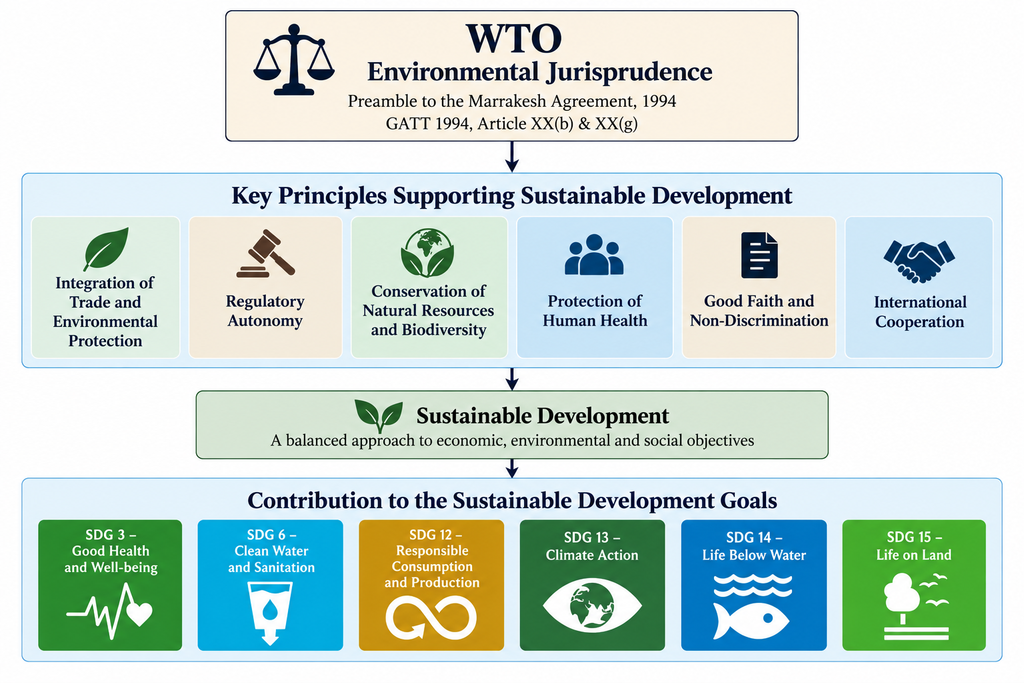
9. Contribution to the SDGs:
The contribution of WTO environmental jurisprudence to the Sustainable Development Goals is primarily indirect. WTO decisions do not themselves implement the SDGs; rather, they preserve legal space for states to adopt environmental and public-health measures consistent with international trade obligations.
i. Good Health and Well being (SDG 3):
Cases such as EC – Asbestos and Brazil – Retreaded Tyres demonstrate states’ ability to regulate environmental hazards that threaten human health.
ii. Clean Water and Sanitation (SDG 6):
WTO environmental exceptions may provide legal space for measures addressing pollution, hazardous substances and environmental degradation affecting water resources.
iii. Responsible Consumption and Production (SDG 12):
Article XX(g) recognizes conservation measures and requires an appropriate relationship with restrictions on domestic production or consumption, discouraging states from imposing environmental burdens only on foreign products.
iv. Climate Action (SDG 13):
WTO environmental jurisprudence provides a legal framework within which climate-related trade measures may be assessed where they pursue legitimate environmental objectives.
v. Life below Water (SDG 14):
US – Shrimp provides a strong connection because it recognized the protection of endangered sea turtles and marine biodiversity as a legitimate conservation objective.
vi. Life on Land (SDG 15):
The broader reasoning of US – Shrimp, particularly the recognition that living species may constitute exhaustible natural resources, supports measures aimed at conserving biodiversity and endangered species.
10. Conclusion:
WTO environmental jurisprudence demonstrates that international trade and sustainable development are capable of operating together. Through Article XX of GATT 1994 and the interpretation developed in cases such as US – Shrimp, US – Gasoline, EC – Asbestos and Brazil – Retreaded Tyres, WTO law recognizes environmental conservation, public health, biodiversity and regulatory autonomy while preventing arbitrary discrimination and disguised protectionism. It therefore aligns with the principles of sustainable development by integrating economic and environmental objectives, conserving natural resources, protecting health, encouraging cooperation and permitting evolutionary interpretation of environmental concepts. At the same time, it contributes to the achievement of important Sustainable Development Goals, particularly SDGs 3, 6, 12, 13, 14 and 15.