
1. Introduction:
International Environmental Law is a branch of international law concerned with the protection of the environment, the prevention and control of environmental harm, the conservation of natural resources, and the promotion of sustainable development. Environmental problems frequently transcend national boundaries; therefore, their effective regulation depends upon rules and principles developed at the international level. The sources of International Environmental Law are largely derived from the traditional sources of public international law. The principal legal framework is found in Article 38(1) of the Statute of the International Court of Justice (ICJ). It recognizes international conventions, international custom and general principles of law, while judicial decisions and the writings of highly qualified publicists serve as subsidiary means for determining rules of law. International Environmental Law has also developed through certain other sources, particularly soft law instruments and, in appropriate circumstances, unilateral acts of States.
2. Sources of International Environmental Law:
The sources may conveniently be divided into:
- Sources under Article 38(1) of the ICJ Statute
- Other Sources
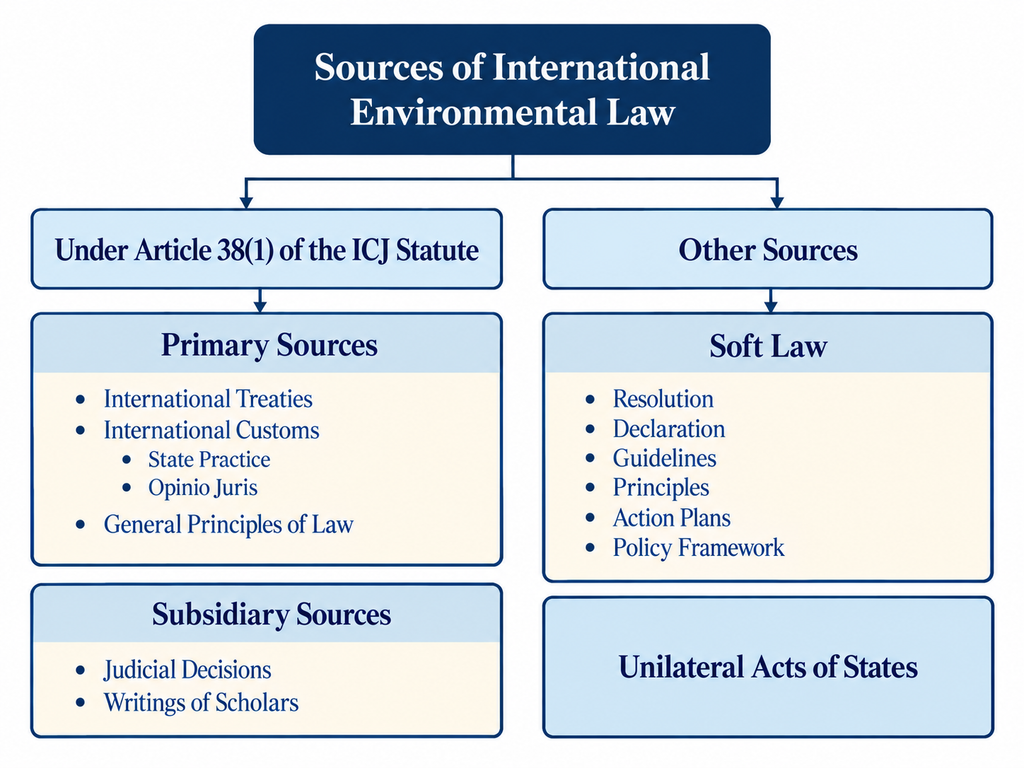
2.1 Sources under Article 38(1) of the ICJ Statute:
Article 38(1) provides the traditional framework for identifying the sources of international law. These may be divided into primary and subsidiary sources.
i. Primary Sources:
A. International Treaties and Conventions:
International treaties and conventions constitute one of the most important formal sources of contemporary International Environmental Law. They contain expressly agreed legal obligations which become binding upon States that consent to be bound by them. Environmental treaties are particularly significant because many environmental problems, such as climate change, depletion of the ozone layer, loss of biodiversity and marine pollution, cannot effectively be addressed by individual States acting alone. Environmental treaties may:
- establish substantive environmental obligations;
- create international institutions and cooperative mechanisms;
- require States to report and monitor environmental performance;
- provide mechanisms for scientific and technical cooperation;
- regulate hazardous activities or substances; and
- progressively develop international environmental standards.
Important Examples:
(a) Vienna Convention for the Protection of the Ozone Layer, 1985:
The Vienna Convention established an international framework for cooperation, research and exchange of information concerning depletion of the ozone layer.
(b) Montreal Protocol, 1987:
The Montreal Protocol supplemented the Vienna Convention by introducing specific controls upon the production and consumption of ozone-depleting substances. It is regarded as an important example of effective international environmental treaty making.
(c) United Nations Framework Convention on Climate Change, 1992:
The UNFCCC established the principal international framework for cooperation concerning climate change.
(d) Convention on Biological Diversity, 1992:
The CBD has three principal objectives:
- conservation of biological diversity;
- sustainable use of its components; and
- fair and equitable sharing of benefits arising from genetic resources.
(e) Paris Agreement, 2015:
The Paris Agreement operates within the UNFCCC framework and constitutes a major contemporary international legal framework for collective action against climate change. Thus, treaty law forms a central pillar of modern International Environmental Law.
B. Customary International Law:
Customary international law is another fundamental source of International Environmental Law. Under Article 38(1)(b) of the ICJ Statute, international custom is based upon a general practice accepted as law. Customary international law therefore requires two essential elements:
State Practice + Opinio Juris = Customary International Law
(a) State Practice:
State practice refers to sufficiently general and consistent conduct of States. It may be reflected in:
- national legislation;
- governmental policies and conduct;
- diplomatic statements;
- international agreements;
- decisions of national courts;
- participation in international organizations; and
- conduct concerning environmental cooperation.
State practice alone, however, is not enough. It must be accompanied by opinio juris.
(b) Opinio Juris:
Opinio juris sive necessitatis refers to the belief of States that a particular practice is followed because international law requires or permits it, rather than merely because of convenience, courtesy or political preference. Accordingly, the combination of State practice and opinio juris may result in the formation of a customary rule of international law.
The No-Harm Principle:
One of the most important customary principles associated with International Environmental Law is the no-harm principle. It requires States to ensure that activities within their jurisdiction or control do not cause significant environmental harm to other States or to areas beyond national jurisdiction. The principle is reflected in:
- Principle 21 of the Stockholm Declaration, 1972, and
- Principle 2 of the Rio Declaration, 1992.
Its development is also associated with the Trail Smelter Arbitration, involving transboundary pollution between Canada and the United States. Customary international law has also contributed to the development of environmental duties concerning prevention, cooperation, notification, consultation and environmental impact assessment in appropriate circumstances.
C. General Principles of Law:
Article 38(1)(c) of the ICJ Statute recognizes general principles of law as another source of international law. General principles are fundamental legal principles recognized across legal systems which may assist international courts and tribunals, particularly where treaty or customary rules do not completely resolve a legal issue. In International Environmental Law, general principles may assist in:
- interpreting environmental obligations;
- determining State responsibility;
- ensuring procedural fairness;
- applying good faith; and
- addressing gaps in existing international law.
Relevant principles may include good faith, equity and principles relating to legal responsibility. However, care must be taken not to classify every environmental principle automatically as a general principle of law. The legal status of concepts such as the precautionary principle, polluter pays principle, and sustainable development depends upon their particular legal foundation and level of international recognition.
ii. Subsidiary Sources:
Article 38(1)(d) identifies judicial decisions and the teachings of highly qualified publicists as subsidiary means for determining rules of law. They principally assist in identifying, interpreting, and clarifying existing legal rules rather than operating in the same manner as treaties or custom.
A. Judicial Decisions:
Judicial decisions play an important role in the development and interpretation of International Environmental Law. They may assist in:
- identifying customary environmental rules;
- interpreting environmental treaties;
- clarifying obligations of States;
- determining responsibility for environmental harm; and
- developing coherent environmental jurisprudence.
Important Environmental Decisions:
(a) Trail Smelter Arbitration (United States v. Canada):
The dispute concerned pollution produced by a Canadian smelter which caused damage within the United States. The tribunal’s reasoning became highly influential in the development of the principle that a State should not permit activities within its territory to cause serious environmental injury in another State. The case is therefore closely associated with the development of the transboundary harm or no-harm principle.
(b) Gabčíkovo-Nagymaros Project (Hungary v. Slovakia, ICJ), 1997
The ICJ considered environmental protection in relation to a major development project. The case emphasized the need to reconcile economic development with environmental protection and became particularly significant in discussions concerning sustainable development.
(c) Pulp Mills on the River Uruguay (Argentina v. Uruguay, ICJ, 2010):
The ICJ considered obligations arising from possible transboundary environmental effects. The case emphasized the importance of international cooperation and environmental impact assessment and contributed significantly to the development of procedural obligations in International Environmental Law. Thus, judicial decisions provide important guidance in determining the meaning and scope of environmental obligations.
B. Writings of Scholars:
Article 38(1)(d) also recognizes the teachings of highly qualified publicists as a subsidiary means for determining rules of international law. The writings of recognized international-law scholars may assist courts, States and legal practitioners in:
- identifying customary international law;
- interpreting treaties;
- examining State practice;
- explaining emerging environmental principles; and
- organizing and clarifying rapidly developing areas of International Environmental Law.
Scholarly writings are especially useful in environmental law because the subject develops alongside changes in science, technology, and international policy. However, scholarly writings do not themselves create binding rules of international law. Their role remains subsidiary and persuasive.
2.2 Other Sources:
International Environmental Law has also been significantly influenced by materials outside the traditional structure of Article 38(1). Two particularly relevant categories are soft law and unilateral acts of States.
i. Soft Law:
Soft law refers broadly to international instruments that are not legally binding in the same manner as treaties, but which may influence State conduct and contribute to the development of international law. Soft law instruments may include:
- declarations;
- resolutions;
- guidelines;
- principles;
- action plans; and
- international policy frameworks.
Soft law is particularly important in International Environmental Law because environmental problems often develop rapidly, and States may initially be unwilling or unable to negotiate binding treaty obligations. Soft law may:
- express international consensus;
- influence State practice;
- contribute to the development of opinio juris;
- guide treaty negotiations;
- provide interpretative guidance;
- influence national environmental legislation; and
- contribute to the progressive development of international environmental norms.
A. Stockholm Declaration, 1972:
The United Nations Conference on the Human Environment, held at Stockholm in 1972, was a major turning point in international environmental governance. The Stockholm Declaration contained important environmental principles, particularly Principle 21, which became highly influential in the development of the no-harm principle.
B. Rio Declaration, 1992:
The Rio Declaration on Environment and Development contains 27 principles and has played a major role in shaping modern environmental law. Its important principles include:
- sustainable development;
- precautionary approach;
- polluter-pays principle;
- public participation;
- common but differentiated responsibilities; and
- prevention of environmental harm.
The legal effect of individual principles must nevertheless be assessed carefully. The fact that a principle appears in a declaration does not automatically make it a binding customary rule.
Other Examples:
Other important soft law instruments include Agenda 21, resolutions adopted by international organizations, environmental guidelines, and international action programs. Soft law may also contribute to the development of binding law. A principle may initially appear in a non-binding declaration, influence State practice and opinio juris, and later become incorporated into a treaty or develop into customary international law.
ii. Unilateral Acts of States:
Although unilateral acts are not expressly listed among the sources contained in Article 38(1), they may have legal consequences in particular circumstances. A unilateral declaration made by a State may create an international legal obligation where the surrounding circumstances demonstrate a clear intention by that State to be legally bound. The Nuclear Tests Cases, 1974, are significant in this respect. The ICJ recognized that unilateral declarations made publicly by States may, in appropriate circumstances, produce binding legal obligations. In International Environmental Law, unilateral undertakings concerning environmental conduct may therefore become legally relevant where the required intention and circumstances are established. However, unilateral acts should not be treated as one of the traditional principal sources of international law. Their legal effect is context dependent.
3. Conclusion:
The sources of International Environmental Law are principally grounded in Article 38(1) of the ICJ Statute, comprising treaties, customary international law and general principles of law, with judicial decisions and scholarly writings serving as subsidiary means. However, the field has also developed a significant reliance on soft law instruments, including the Stockholm Declaration, Rio Declaration, and Agenda 21, which have contributed substantially to the progressive development of environmental norms. Unilateral acts of States may, in appropriate circumstances, also give rise to legal consequences. Thus, International Environmental Law derives its normative strength from the interaction of binding rules, judicial interpretation, scholarly authority, and influential non-binding instruments, collectively shaping the legal framework for international environmental protection.