
1. Introduction:
Shehla Zia and others v. WAPDA, PLD 1994 SC 693, is a landmark judgment of the Supreme Court of Pakistan concerning environmental protection and fundamental rights. The case is significant for the broad interpretation of Article 9, relating to the right to life, and Article 14, relating to human dignity, through which environmental concerns were brought within the constitutional framework. It also played an important role in the development of the precautionary approach, public interest litigation and rights based environmental jurisprudence in Pakistan.
2. Case Citation and Basic Information:
Case:
Shehla Zia and others v. WAPDA
Citation:
PLD 1994 SC 693
Court:
Supreme Court of Pakistan
Date:
12 February 1994
Constitutional Provisions:
- Article 9 — Security of person / right to life and liberty
- Article 14 — Inviolability of dignity of man and privacy of home
- Article 184(3) — Supreme Court’s original jurisdiction in matters involving public importance with reference to enforcement of Fundamental Rights
The official judgment records the matter as Human Rights Case No. 15-K of 1992.
3. Background and Facts of the Case:
Residents of a locality in Islamabad became concerned about a proposal by the Water and Power Development Authority (WAPDA) to construct an electrical grid station in or near their residential area. The proposed installation involved high-voltage electrical equipment and transmission lines. The residents raised several objections. Their principal concerns were:
- The electromagnetic fields associated with high-voltage transmission facilities could pose risks to human health.
- Children, elderly persons and other residents living close to the installation could potentially be exposed to those risks.
- The proposed project would affect the area’s green belt.
- The project could adversely affect the residential environment and quality of life.
The petitioners relied upon scientific studies and material suggesting possible health effects from electromagnetic fields. However, the scientific evidence was not conclusive. WAPDA, on the other hand, maintained that there was no established scientific proof demonstrating that the proposed grid station would cause the alleged health consequences. This scientific uncertainty became one of the most important features of the case.
4. How the Matter Reached the Supreme Court:
The matter reached the Supreme Court through its constitutional and human rights jurisdiction. The Court treated the petition as involving questions of public importance concerning fundamental rights. The judgment identified two important questions:
- Whether a government agency could undertake an activity capable of endangering the lives and health of citizens without adequate legal protection; and
- Whether rights associated with the residential area and zoning arrangements could be altered without properly considering the interests of the residents.
This aspect is important because the case was not merely an ordinary dispute between a few residents and WAPDA. The Court recognized the wider public dimension of the alleged environmental and health risk.
5. The Main Legal Issues:
The case raised several important legal questions:
5.1 Scope of Article 9:
What does the constitutional expression “life” mean? Does it merely mean physical or biological existence, or does it include the conditions necessary for a meaningful human life?
5.2 Environmental and Health Hazards:
Could citizens seek constitutional protection against a potential environmental or technological hazard even before actual injury occurred?
5.3 Article 14 and Human Dignity:
Could the right to life be understood together with the constitutional protection of human dignity?
5.4 Scientific Uncertainty:
Could the State proceed with a potentially hazardous project merely because scientific research had not conclusively established the existence of harm?
5.5 Public Interest Litigation:
Could citizens invoke the Supreme Court’s constitutional jurisdiction to prevent a potential violation of fundamental rights affecting a wider section of society? These questions made the case much more significant than an ordinary dispute concerning the location of a power installation.
6. Judgment of the Supreme Court:
The Supreme Court adopted a broad and progressive interpretation of Article 9. The Court held that the word “life” cannot be restricted to mere physical, vegetative, or animal existence. It encompasses the various facets of human existence and the amenities and facilities necessary for a person to enjoy life with dignity. The Court further held that a person is entitled to protection of law against hazards arising from electromagnetic fields and similar hazards associated with installations such as grid stations, factories and power stations. This was the central constitutional breakthrough of the case.
7. Expansion of the Right to Life under Article 9:
A major contribution of Shehla Zia v. WAPDA was the expansion of the meaning of the right to life under Article 9. The Supreme Court rejected the narrow view that life merely means physical or biological existence. It held that life includes those conditions, facilities and amenities which are necessary for a person to live meaningfully and with dignity. Accordingly, the constitutional protection of life extends beyond mere survival and may include protection against serious environmental conditions that threaten human health, safety and well-being. This broad interpretation enabled environmental protection to be brought within the scope of Article 9 even before the Constitution expressly recognized a separate environmental right.
8. Environmental Protection as a Fundamental Rights Issue:
Shehla Zia significantly changed the constitutional status of environmental protection in Pakistan. The Supreme Court recognized that environmental harm is not merely a matter of administration, regulation or planning where it seriously affects human life and dignity. By connecting environmental protection with Article 9, which protects life and liberty, and Article 14, which protects human dignity, the Court treated serious environmental risks as matters capable of involving fundamental rights. The case therefore established that environmental protection may acquire constitutional significance whenever environmental degradation threatens the health, safety or dignified existence of individuals.
9. Precautionary Approach:
The case is also significant for the Court’s precautionary approach toward environmental and health risks. The scientific evidence concerning electromagnetic fields was inconclusive. The precise extent of the potential harm had not been conclusively established. However, the Court did not regard scientific uncertainty as sufficient reason to ignore the possible danger. The underlying principle was that where there is a reasonable possibility of serious environmental or health harm, authorities should consider protective measures rather than waiting for irreversible injury to occur.
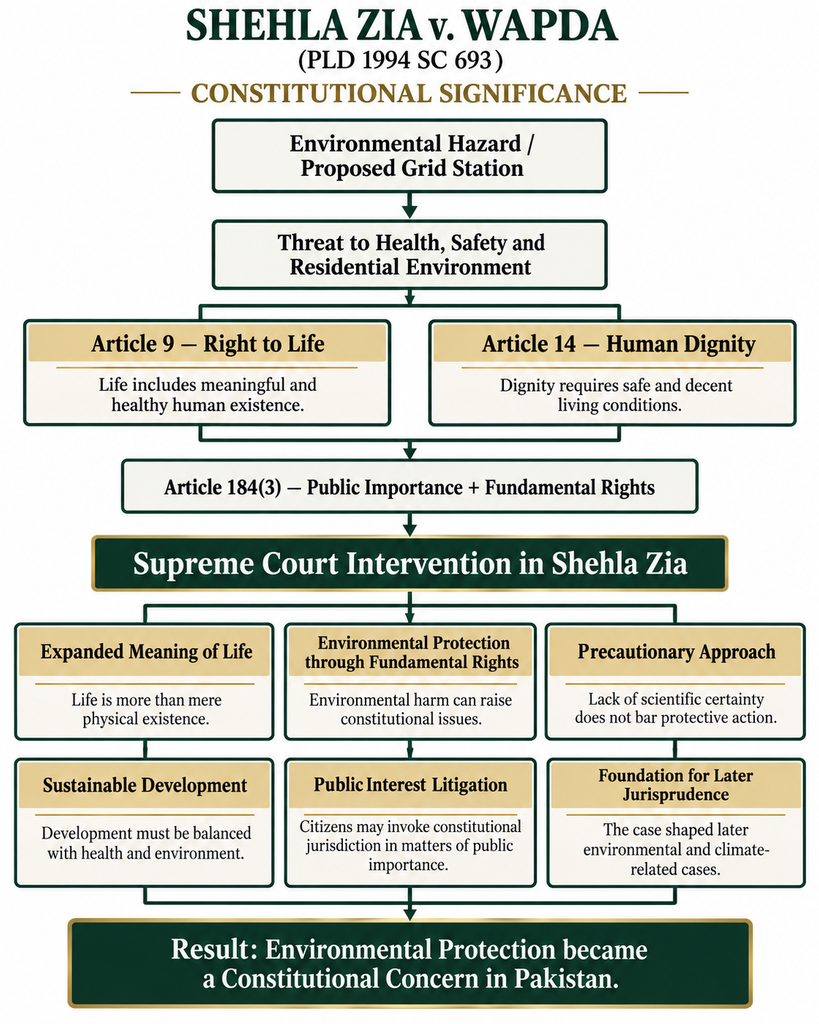
10. Significance of Shehla Zia v. Wapda:
The significance of Shehla Zia v. WAPDA lies in the important constitutional and environmental principles developed through the judgment. The case expanded the scope of fundamental rights, strengthened judicial protection against environmental harm, and influenced the subsequent development of environmental jurisprudence in Pakistan. Its major contributions may be discussed under the following headings:
i. Expanded Meaning of Right to Life under Article 9:
One of the most important contributions of Shehla Zia v. WAPDA was the broad interpretation of the right to life under Article 9. The Supreme Court held that “life” is not confined to mere physical or biological existence but includes the conditions, facilities and amenities necessary for a meaningful and dignified human existence. This interpretation enabled threats to health, safety and environmental quality to be examined within the constitutional protection of life.
ii. Environmental Protection through Fundamental Rights:
The judgment brought environmental protection within the framework of fundamental rights even though, at that time, the Constitution contained no separate fundamental right to a clean and healthy environment. By linking environmental hazards with the right to life under Article 9 and human dignity under Article 14, the Court established that serious environmental harm could raise constitutional questions rather than remaining merely a regulatory or administrative concern.
iii. Application of the Precautionary Approach:
A major significance of the case was the Court’s adoption of a precautionary approach where scientific evidence regarding the harmful effects of electromagnetic fields was inconclusive. The Court recognized that the absence of complete scientific certainty should not prevent reasonable protective measures where a potentially serious threat to human health or the environment exists. The judgment therefore strengthened the preventive character of environmental protection in Pakistan.
iv. Recognition of Sustainable Development:
The judgment also reflected the principle that development and environmental protection must be reconciled. Economic and technological development cannot be pursued without considering its effects on human life, public health and environmental safety. In this sense, Shehla Zia contributed to the development of the concept of sustainable development by emphasizing the need to balance developmental objectives with environmental concerns.
v. Expansion of Public Interest Litigation:
Shehla Zia also strengthened the role of public interest litigation in environmental matters. The Supreme Court entertained the matter under Article 184(3) because it involved questions of public importance relating to fundamental rights. By treating the residents’ concerns as more than an ordinary private dispute, the Court facilitated judicial consideration of environmental and public health issues affecting wider sections of society.
vi. Use of International Environmental Principles:
The judgment demonstrated the relevance of international environmental principles in the development of domestic constitutional jurisprudence. The Court referred to emerging international environmental thinking, particularly the precautionary approach, while considering the risks involved in the proposed project. This showed that international environmental principles may assist Pakistani courts in interpreting constitutional rights and developing environmental law.
vii. Judicial Scrutiny of Environmentally Risky Development:
Another important contribution of Shehla Zia was the recognition that development projects involving serious environmental or health risks are subject to constitutional and judicial scrutiny. Public authorities cannot treat developmental decisions as immune from review where fundamental rights may be affected. The judgment therefore strengthened judicial oversight of governmental and administrative decision-making involving environmental consequences.
viii. Foundation for Later Environmental Jurisprudence:
The principles developed in Shehla Zia became an important foundation for the subsequent growth of rights-based environmental jurisprudence in Pakistan. Later environmental and climate-related litigation could build upon the proposition that serious environmental harm may implicate constitutional rights to life and dignity. The case consequently remains a foundational authority in the judicial development of environmental protection.
ix. Influence on Environmental Governance:
The judgment also contributed to the broader development of environmental governance and regulatory accountability in Pakistan. It emphasized the need for public authorities to consider environmental and health consequences when undertaking or approving development projects and reinforced the importance of environmental assessment, regulation, and institutional oversight. Its constitutional approach formed part of the broader evolution of Pakistan’s modern environmental legal framework.
11. Conclusion:
The enduring importance of Shehla Zia v. WAPDA lies in the constitutional method adopted by the Supreme Court. The judgment showed that existing fundamental rights could be interpreted dynamically to respond to emerging environmental and public health concerns. By allowing preventive judicial intervention even in the face of scientific uncertainty, the case moved Pakistani environmental law toward a more rights-oriented and precautionary framework. Its principles continued to shape later environmental adjudication and helped prepare the constitutional ground for the subsequent express recognition of environmental rights.