
1. Introduction:
The Pakistan Environmental Protection Act, 1997 (PEPA 1997) is the principal federal environmental legislation enacted to provide a comprehensive framework for environmental protection, conservation, rehabilitation and improvement, as well as for the prevention and control of pollution and promotion of sustainable development. It was enacted on 6 December 1997 and repealed the Pakistan Environmental Protection Ordinance, 1983. The Act marked an important development in Pakistan’s environmental law by moving beyond general environmental policy and establishing institutions, regulatory standards, environmental assessment procedures, enforcement mechanisms and specialized adjudicatory bodies.
2. Objectives of PEPA 1997:
The principal objectives of the Act, reflected particularly in its preamble and substantive provisions, are as follows:
i. Protection of the Environment:
The primary objective of PEPA 1997 is the protection of the environment from activities capable of causing environmental degradation. The Act adopts a broad approach covering air, water, land, atmosphere and ecological systems.
ii. Conservation of Natural Resources:
The Act seeks to promote the conservation and sustainable use of natural resources, biodiversity, and ecological systems. Environmental resources are to be utilized in a manner compatible with long-term environmental protection.
iii. Prevention and Control of Pollution:
A central purpose of the Act is the prevention and control of pollution arising from industrial, commercial, municipal and other activities. It establishes legal standards and regulatory mechanisms for controlling pollutants, effluents, emissions and other environmentally harmful discharges.
iv. Rehabilitation and Improvement of the Environment:
PEPA 1997 is not confined to preventing future environmental damage. It also contemplates the rehabilitation and improvement of degraded environments and environmental resources.
v. Promotion of Sustainable Development:
The Act seeks to reconcile economic development with environmental protection through the principle of sustainable development. Development is therefore to proceed in a manner that meets present needs while preserving environmental resources and ecological interests for future generations.
3. Key Features of PEPA 1997:
i. Establishment of Environmental Institutions:
One of the major features of PEPA 1997 is the creation of an institutional framework for environmental governance. The Act provides for bodies including the Pakistan Environmental Protection Council and the Pakistan Environmental Protection Agency, with functions relating to environmental policy, coordination, implementation and enforcement. The Council performs important policy and supervisory functions, while the Agency is entrusted with implementing and enforcing environmental laws, policies and standards.
ii. National Environmental Quality Standards (Section 6):
A significant regulatory mechanism under the Act is the National Environmental Quality Standards (NEQS). Under section 6, the Pakistan Environmental Protection Agency is entrusted with preparing, revising and establishing the NEQS with the approval of the Pakistan Environmental Protection Council. These standards provide measurable environmental limits relating to matters such as effluents, emissions, air pollutants, noise and other environmental contaminants.
Prohibition under Section 11:
Section 11 strengthens this regulatory system by prohibiting the discharge or emission of any effluent, waste, air pollutant or noise in excess of the applicable NEQS or other prescribed standards. Thus, the NEQS convert environmental protection from a general policy objective into enforceable regulatory standards.
iii. Initial Environmental Examination and Environmental Impact Assessment (Section 12):
Section 12 establishes one of the most important preventive mechanisms under PEPA 1997. A project proponent cannot commence construction or operation of a prescribed project unless the required environmental assessment has been filed with the relevant environmental protection agency and approval has been obtained. The Act recognizes two principal forms of assessment:
- Initial Environmental Examination (IEE): generally applicable where the project is unlikely to cause significant adverse environmental effects.
- Environmental Impact Assessment (EIA): required where a project is likely to cause significant adverse environmental effects.
The purpose is to ensure that environmental consequences are identified and considered before potentially damaging development takes place, rather than merely attempting to remedy the damage afterwards.
iv. Prohibition of Import of Hazardous Waste (Section 13):
Section 13 prohibits the import of hazardous waste into Pakistan and its territorial waters, Exclusive Economic Zone and historic waters. This provision protects Pakistan from becoming a destination for dangerous or toxic waste generated elsewhere and reduces risks to human health, ecosystems and environmental quality.
v. Regulation of Hazardous Substances (Section 14):
Section 14 regulates dealings with hazardous substances. No person may generate, collect, consign, transport, treat, dispose of, store, handle or import a hazardous substance except under a license issued by the relevant authority or in accordance with other applicable law or international agreements to which Pakistan is a party. The provision therefore establishes legal control over hazardous substances throughout their handling and management cycle.
vi. Regulation of Motor Vehicle Pollution (Section 15):
PEPA 1997 specifically addresses pollution caused by motor vehicles. Section 15 prohibits the operation of a motor vehicle from which air pollutants or noise are emitted in excess of the prescribed standards. The authorities may take prescribed measures for testing and controlling vehicular emissions. This provision recognizes transport-related air and noise pollution as an important component of environmental regulation.
vii. Environmental Protection Orders (Section 16):
Section 16 provides an important enforcement mechanism through Environmental Protection Orders. Where the relevant environmental protection agency is satisfied that the discharge or emission of pollutants, disposal of waste, handling of hazardous substances or another activity is causing, has caused, or is likely to cause an adverse environmental effect, it may issue an Environmental Protection Order (EPO). An EPO may require appropriate measures to prevent, control, reduce or remedy environmental damage, including alteration or cessation of the offending activity where legally warranted. This gives environmental authorities a mechanism for direct regulatory intervention, rather than relying solely upon prosecution after damage has occurred.
viii. Penalties for Environmental Violations (Section 17):
Section 17 provides penalties for contraventions of important provisions of PEPA 1997. Violations relating to pollution standards, environmental assessment, hazardous waste, hazardous substances and other statutory requirements may attract substantial monetary penalties, with additional penalties in cases of continuing contravention. The penalty regime gives the Act its deterrent and enforcement character, ensuring that its environmental obligations are not merely declaratory.
ix. Environmental Tribunals (Sections 20–22):
The Act establishes Environmental Tribunals for specialized adjudication of environmental offences and disputes falling within their statutory jurisdiction. The Tribunals provide a specialized forum capable of dealing with the technical and legal dimensions of environmental matters. The Act also regulates their jurisdiction, procedure and appellate framework. This institutional mechanism recognizes that environmental disputes frequently require specialized legal and technical consideration.
x. Provincial Sustainable Development Funds (Sections 9–10):
PEPA 1997 provides for the establishment of Provincial Sustainable Development Funds. These funds are intended to provide financial support for projects contributing to environmental protection, conservation, rehabilitation, improvement, and sustainable development. The Fund mechanism, therefore, supplements regulatory enforcement with a financial mechanism for positive environmental action.
4. Significance of PEPA 1997:
PEPA 1997 marked an important development in Pakistan’s environmental legal framework by moving beyond a purely reactive approach to environmental harm. It established an integrated system in which environmental protection is pursued through preventive measures, regulatory standards, institutional oversight, enforcement mechanisms and sustainable development. The significance of the Act lies in the way these mechanisms operate together as a comprehensive framework for environmental governance.
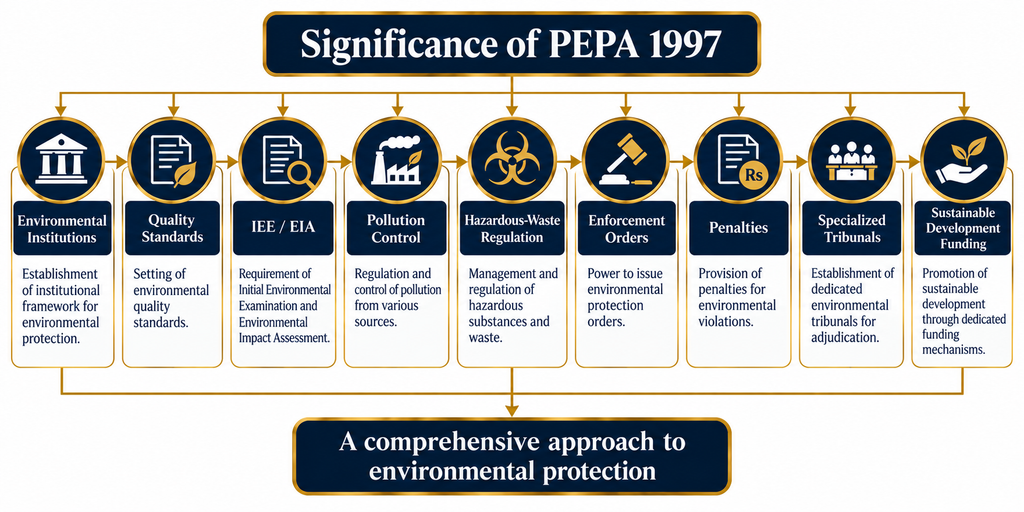
Thus, the Act addresses environmental protection at several stages: before environmental harm occurs, while potentially harmful activities are being conducted, and after a statutory violation has taken place.
5. Conclusion:
The Pakistan Environmental Protection Act, 1997 provides a comprehensive statutory framework for environmental governance in Pakistan. Its principal objectives are the protection, conservation, rehabilitation, and improvement of the environment, prevention and control of pollution, and promotion of sustainable development. These objectives are implemented through an integrated regulatory structure comprising environmental institutions, National Environmental Quality Standards, IEE and EIA requirements, regulation of hazardous waste and substances, control of motor-vehicle pollution, Environmental Protection Orders, penalties, Environmental Tribunals and Sustainable Development Funds. PEPA 1997 therefore constitutes a foundational statute in the development of Pakistan’s modern environmental law framework.