
1. Introduction
Climate change refers to long term alterations in the Earth’s temperature and weather patterns. Although natural processes can influence the climate, the present phase of global warming is predominantly caused by human activities. Since the Industrial Revolution, the large scale combustion of fossil fuels, destruction of forests, expansion of industries and intensification of agriculture have substantially increased the concentration of greenhouse gases in the atmosphere. These gases reinforce the natural greenhouse effect, disturb the Earth’s energy balance and cause global temperatures to rise. The principal human induced causes of climate change are:
- Greenhouse gas emissions;
- Deforestation and land-use change;
- Industrialization; and
- Agriculture and livestock production.
2. Greenhouse Gas Emissions:
Greenhouse gas emissions constitute the direct and central cause of anthropogenic climate change. Greenhouse gases allow sunlight to reach the Earth’s surface but absorb and reemit part of the outgoing infrared heat. This process is known as the greenhouse effect. The natural greenhouse effect makes the Earth habitable. The problem arises when human activities add excessive quantities of greenhouse gases to the atmosphere, thereby producing an enhanced greenhouse effect and accelerating global warming.
A. Carbon Dioxide (CO₂):
Carbon dioxide is the principal greenhouse gas responsible for long term human-induced warming. It is released mainly through:
- Burning coal, oil and natural gas;
- Generation of electricity and heat;
- Road, air and maritime transport;
- Industrial manufacturing;
- Production of cement;
- Burning of forests and vegetation; and
- Changes in the use of land.
Fossil fuels contain carbon that has remained underground for millions of years. When they are burned, this carbon combines with oxygen and enters the atmosphere as carbon dioxide. A considerable part of this additional CO₂ remains in the climate system for a very long period, producing a cumulative warming effect.
B. Methane (CH₄):
Methane is emitted in smaller quantities than carbon dioxide, but it is a particularly potent greenhouse gas. Its principal human sources include:
- Enteric fermentation in cattle, sheep and goats;
- Storage and treatment of livestock manure;
- Flooded rice fields;
- Landfills and wastewater;
- Coal mining;
- Oil and natural-gas production; and
- Leakage during the transportation of fossil fuels.
Methane remains in the atmosphere for a shorter period than carbon dioxide, but it traps considerably more heat per unit of gas over the short term. Controlling methane emissions can therefore produce relatively rapid climate benefits.
C. Nitrous Oxide (N₂O):
Nitrous oxide is a long-lived and powerful greenhouse gas. Human activities that release it include:
- Excessive application of synthetic nitrogen fertilizers;
- Management of animal manure;
- Cultivation and disturbance of agricultural soils;
- Burning of biomass and fossil fuels; and
- Certain chemical and industrial processes.
When more nitrogen fertilizer is applied than crops can absorb, microorganisms in the soil convert part of the remaining nitrogen into nitrous oxide, which escapes into the atmosphere.
D. Fluorinated Gases:
Fluorinated gases are synthetic gases used in refrigeration, air conditioning, electronics, insulation and certain manufacturing processes. They include hydrofluorocarbons and other industrial gases. Although they are generally emitted in comparatively small quantities, many fluorinated gases possess an exceptionally high global warming potential and may remain in the atmosphere for long periods. Leakage from cooling systems and improper disposal of equipment can therefore make a disproportionate contribution to warming.
Overall Role of Greenhouse Gases:
The accumulation of these gases creates an imbalance between the solar energy entering the Earth’s system and the heat escaping into space. The resulting warming affects rainfall patterns, glaciers, oceans, ecosystems and the frequency or severity of certain extreme weather events. Thus, greenhouse gas accumulation is the principal mechanism through which human activities cause climate change.
3. Deforestation and Land Use Change:
Forests perform a vital climatic function by acting as carbon sinks. Through photosynthesis, trees absorb carbon dioxide from the atmosphere and store carbon in their trunks, branches, roots and surrounding soils.
How Deforestation Causes Climate Change:
Deforestation contributes to climate change in two interconnected ways:
A. Release of Stored Carbon:
When trees are cut and burned, much of their stored carbon is immediately released into the atmosphere as carbon dioxide. Even where timber is not burned, carbon is gradually released when vegetation and wood decay. Disturbing forest soils may also release carbon accumulated in the soil over long periods.
B. Loss of Carbon Absorption Capacity:
The destruction of forests removes trees that would otherwise continue absorbing atmospheric carbon dioxide. Deforestation therefore not only creates new emissions but also weakens the Earth’s natural capacity to remove existing CO₂ from the atmosphere.
Principal Causes of Deforestation
Forests are commonly cleared for:
- Agricultural expansion;
- Livestock grazing;
- Commercial logging;
- Extraction of fuelwood;
- Mining;
- Construction of roads and dams;
- Housing and urban development; and
- Other infrastructure projects.
- Broader Climatic Consequences
Forests also influence local rainfall, soil moisture, evaporation and surface temperature. Their removal can disrupt regional water cycles, intensify soil erosion and increase vulnerability to droughts, floods and desertification. Accordingly, deforestation has a dual climatic effect: it releases stored carbon while simultaneously diminishing the planet’s ability to absorb future emissions.
3. Industrialization:
Industrialization has transformed economies and improved material living standards, but it has also significantly increased the scale of energy consumption and greenhouse gas emissions. Since the Industrial Revolution, industrial development has remained heavily dependent upon fossil fuels.
A. Fossil Fuel Based Energy:
Factories, power plants and industrial facilities require substantial amounts of energy. Where that energy is produced by burning coal, oil or natural gas, large quantities of carbon dioxide are released. Coal based electricity generation is particularly carbon intensive. Industries may also generate emissions indirectly by consuming electricity supplied through fossil-fuel-based power systems.
B. Manufacturing Processes
Energy intensive industries include:
- Iron and steel;
- Cement;
- Chemicals;
- Fertilizers;
- Plastics;
- Textiles;
- Paper; and
- Construction materials.
Some emissions arise from the fuel used to heat furnaces and operate machinery. Others result directly from chemical reactions within production processes. For example, cement manufacture releases CO₂ both from burning fuel and from calcination, the chemical process through which limestone is converted into clinker. Such emissions cannot be eliminated merely by improving energy efficiency.
C. Transportation and Global Trade:
Industrialization has expanded transportation networks and international supply chains. The following predominantly depend upon petroleum based fuels:
- Cars and motorcycles;
- Trucks and buses;
- Ships;
- Aircraft; and
- Industrial machinery.
Transportation produces carbon dioxide through fuel combustion. It may also release nitrogen oxides and black carbon, which can affect atmospheric warming and air quality.
D. Construction and Urbanization:
Rapid urbanization generates demand for cement, steel, glass and other energy-intensive materials. Cities also increase electricity consumption, transportation activity, cooling requirements and waste generation. Dark roads and buildings absorb heat, while the reduction of vegetation limits natural cooling. This creates an urban heat-island effect, which may intensify local heat and increase the demand for air conditioning, thereby producing additional emissions where electricity is fossil fuel-based.
E. Industrial Waste:
Industrialization produces large volumes of solid waste and wastewater. Organic waste in landfills decomposes without sufficient oxygen and releases methane. Incineration can also release carbon dioxide and other pollutants unless properly controlled. Therefore, industrialization contributes to climate change through energy consumption, process emissions, transportation, construction, resource extraction and waste generation.
4. Agriculture and Livestock Production:
Agriculture is indispensable for human survival, but modern intensive agriculture contributes substantially to climate change. Its principal emissions are methane and nitrous oxide, although agricultural machinery, land clearing and food transportation also release carbon dioxide.
A. Livestock:
Ruminant animals including cattle, buffaloes, sheep and goats produce methane during digestion through a process called enteric fermentation. The methane is then released mainly through belching. Livestock manure can produce:
- Methane when stored under oxygen-deficient conditions; and
- Nitrous oxide during its storage, treatment and application to land.
Livestock farming may also indirectly cause deforestation where forests are cleared to create grazing land or grow animal feed.
B. Rice Cultivation:
Rice is commonly grown in flooded fields. Waterlogged soil contains little oxygen, creating anaerobic conditions in which microorganisms decompose organic matter and generate methane. Rice cultivation is consequently an important agricultural source of methane, particularly where fields remain continuously flooded.
C. Synthetic Fertilizers:
Modern agriculture relies heavily on nitrogen based fertilizers to increase crop yields. Crops do not absorb all the nitrogen applied to the soil. Microorganisms convert part of the surplus nitrogen into nitrous oxide. Excessive and inefficient fertilizer application therefore increases greenhouse gas emissions while also contributing to water pollution and soil degradation.
D. Agricultural Land Use Change:
Forests, grasslands and wetlands are frequently converted into agricultural land. This process releases the carbon stored in vegetation and soil. Draining peatlands is especially damaging because peat soils contain large stores of carbon that are released when exposed to air, cultivated or burned.
E. Agricultural Machinery and Food Supply Chains:
Tractors, irrigation pumps, harvesting equipment, processing plants and transportation vehicles commonly rely on fossil fuels. Additional emissions arise from:
- Manufacture of fertilizers and pesticides;
- Refrigeration and cold storage;
- Packaging and processing;
- Transportation of agricultural products; and
- Disposal of food waste.
Thus, the climatic impact of agriculture extends beyond farms and encompasses the entire food production and distribution system.
5. Interrelationship Between the Major Causes:
These causes do not operate independently; rather, they reinforce one another:
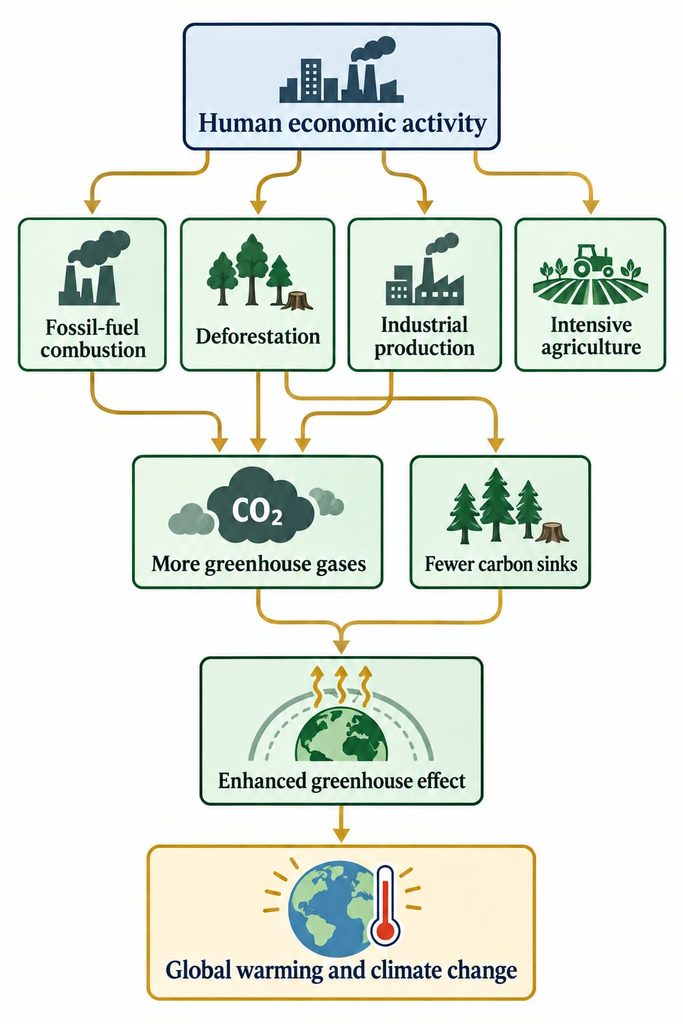
For example, industrial and agricultural expansion may cause deforestation; deforestation releases carbon and removes carbon sinks; industrial machinery and transportation burn fossil fuels; and agriculture releases methane and nitrous oxide. Their combined effect is a sustained increase in atmospheric greenhouse gas concentrations.
6. Conclusion:
Contemporary climate change is fundamentally linked to the manner in which human societies produce energy, use land, manufacture goods, transport people and commodities, and produce food. Fossil fuel combustion releases vast quantities of carbon dioxide; deforestation liberates stored carbon and destroys natural carbon sinks; industrialization magnifies emissions through energy-intensive production and transport; and modern agriculture generates significant methane and nitrous oxide emissions. Greenhouse gas emissions are therefore the immediate physical cause of human-induced warming, while deforestation, industrialization, and agriculture are among the principal activities that generate those emissions. Effective climate action must consequently address both sides of the problem: reducing emissions at their sources and protecting or restoring the natural systems capable of absorbing carbon.