
1. Introduction:
The World Trade Organization (WTO) was established primarily to promote international trade by reducing trade barriers and preventing discriminatory trade practices. However, WTO law also recognizes the importance of environmental protection and sustainable development. The Marrakesh Agreement, 1994, which established the WTO, refers in its preamble to sustainable development and the need to protect and preserve the environment. The principal legal basis for environmental protection under WTO law is therefore found in Article XX of the General Agreement on Tariffs and Trade (GATT) 1994, which provides general exceptions to otherwise applicable trade obligations. Among these exceptions, Article XX(b) and Article XX(g) are particularly important for environmental protection. However, even when a measure falls within either exception, it must also satisfy the requirements of the Chapeau, or introductory paragraph, of Article XX.
2. Article XX of GATT 1994: General Legal Basis
Article XX permits WTO members to adopt certain measures that may otherwise be inconsistent with their GATT obligations, provided that the conditions of the relevant exception are satisfied. This is important because environmental regulations may sometimes restrict international trade or affect obligations such as:
- Most-Favoured-Nation treatment under Article I; and
- National Treatment under Article III.
Article XX therefore provides a legal mechanism through which WTO members can pursue legitimate environmental objectives while remaining within the WTO framework. For environmental protection, the two principal exceptions are Article XX(b) and Article XX(g).
3. Article XX(b): Protection of Human, Animal or Plant Life or Health
Article XX(b) allows measures that are “necessary to protect human, animal or plant life or health.” This provision provides a legal basis for environmental measures designed to prevent environmental harm that threatens human, animal, or plant health.
The Necessity Test:
The central requirement is that the measure must be necessary to achieve the relevant protective objective. WTO jurisprudence applies a weighing and balancing approach, considering factors including:
- the importance of the objective;
- the contribution of the measure to achieving that objective; and
- the trade restrictiveness of the measure.
The availability of a reasonably practicable and less trade restrictive alternative is also relevant.
EC – Asbestos:
In European Communities – Asbestos, the WTO Appellate Body recognized the serious risks posed by asbestos to human health and accepted that measures restricting asbestos-containing products could be justified under Article XX(b).
Principle: Protection of human life and health is a highly important objective capable of justifying trade restrictive measures where the requirements of Article XX are satisfied.
4. Article XX(g): Conservation of Exhaustible Natural Resources
Article XX(g) permits measures “relating to the conservation of exhaustible natural resources,” provided that such measures are made effective in conjunction with restrictions on domestic production or consumption. This provision is particularly important for the conservation of natural resources and biodiversity. Unlike Article XX(b), Article XX(g) does not require the measure to be “necessary.” Instead, there must be a genuine and substantial relationship between the measure and the conservation objective.
i. Exhaustible Natural Resources:
The expression “exhaustible natural resources” has been interpreted broadly by WTO jurisprudence. It is not confined to minerals, petroleum, or other non living resources; it may also extend to living natural resources and endangered species.
Case Law: US – Shrimp:
In US – Shrimp, the WTO Appellate Body applied this broad interpretation and held that sea turtles constituted exhaustible natural resources within the meaning of Article XX(g). The case therefore established that living and endangered species may fall within the protection of Article XX(g).
ii. “Relating to” Conservation:
Article XX(g) requires the measure to be “relating to” the conservation of the relevant natural resource. Unlike Article XX(b), it does not require the measure to be “necessary.” There must, however, be a genuine relationship between the measure and the conservation objective.
The measure must also be made effective “in conjunction with restrictions on domestic production or consumption.” This means that a country cannot simply impose conservation restrictions on imported products while allowing unrestricted domestic production or consumption that undermines the same conservation objective.
5. The Chapeau of Article XX:
The Chapeau is the introductory paragraph of Article XX. It is crucial because satisfying Article XX(b) or Article XX(g) does not automatically make a measure WTO-consistent. The Chapeau provides that measures falling within Article XX must not be applied in a manner that constitutes:
- arbitrary discrimination between countries where the same conditions prevail;
- unjustifiable discrimination between countries where the same conditions prevail; or
- a disguised restriction on international trade.
Therefore, the Chapeau acts as a safeguard against the misuse of environmental exceptions for protectionist purposes.
6. Role and Purpose of the Chapeau:
i. Prevents Abuse of Environmental Exceptions:
The Chapeau prevents a WTO member from using environmental protection as a mere justification for protecting its domestic industries from foreign competition. Thus, a legitimate environmental objective does not give a country unlimited freedom to restrict imports.
ii. Ensures Non Discriminatory Application:
An environmental measure must not arbitrarily or unjustifiably discriminate between countries in which the same conditions prevail. The focus is therefore not merely on the environmental objective of the measure but also on how the measure is actually applied.
iii. Requires Flexibility:
The Chapeau is particularly important where countries have different environmental conditions, technologies, and regulatory systems. In US v. Shrimp, the WTO Appellate Body emphasized the importance of allowing sufficient flexibility and taking into account different conditions in exporting countries rather than imposing a rigid, one-size-fits-all approach.
iv. Promotes Transparency and Fair Administration:
Environmental trade measures should be administered in a manner that is transparent, predictable and fair. Procedural fairness, opportunities for consultation and reasonable implementation procedures can therefore be relevant when determining whether a measure satisfies the Chapeau.
v. Prevents Disguised Restrictions on Trade:
The Chapeau ensures that an environmental measure is not merely a hidden form of trade protectionism. The environmental objective must therefore be genuine, and the measure must not be applied as a disguised restriction on international trade.
7. Relationship Between Article XX(b), XX(g) and the Chapeau:
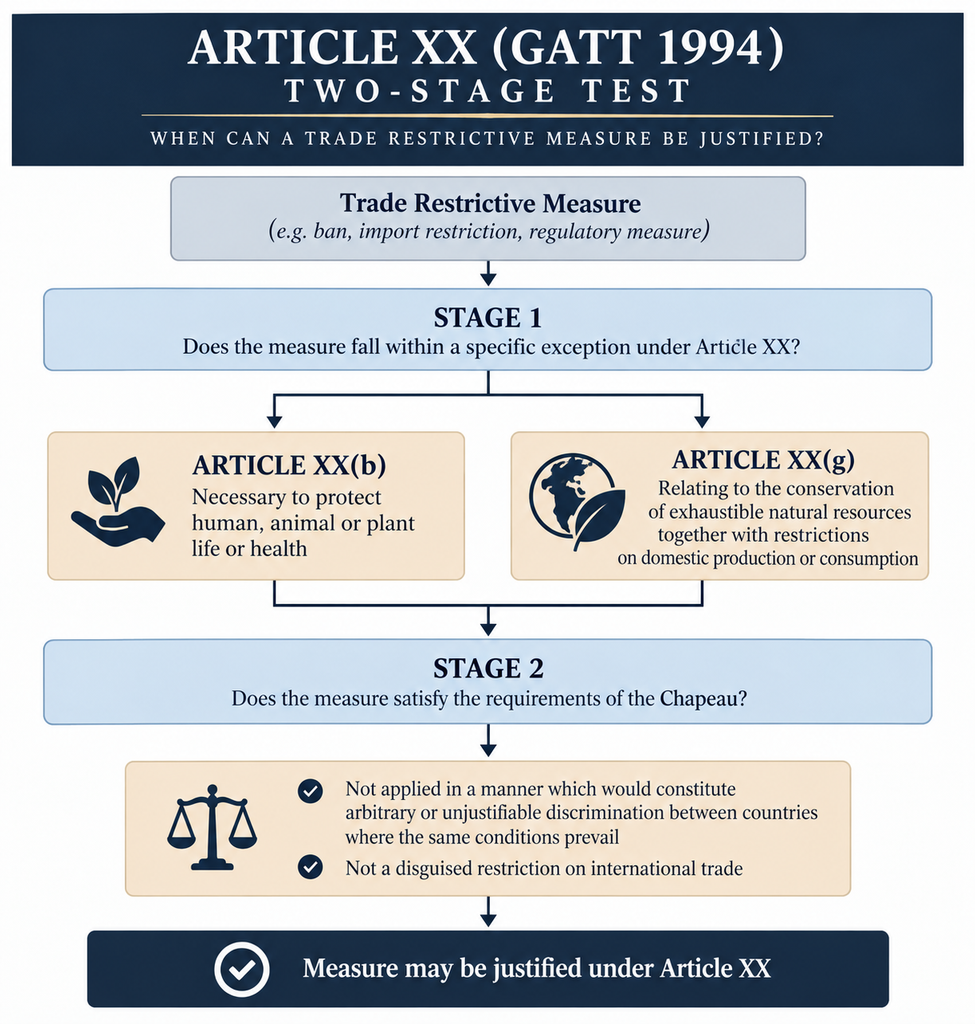
The legal operation of Article XX can be understood as a two-stage test.
First Stage: Specific Exception
The member must establish that the measure falls within a specific exception:
- Article XX(b): the measure is necessary to protect human, animal or plant life or health; or
- Article XX(g): the measure relates to the conservation of an exhaustible natural resource and is applied in conjunction with domestic restrictions.
Second Stage: Chapeau
Even if the measure satisfies Article XX(b) or Article XX(g), it must still satisfy the Chapeau. It must not be applied in a manner that amounts to:
- arbitrary discrimination;
- unjustifiable discrimination; or
- a disguised restriction on international trade.
Therefore, Article XX(b) and Article XX(g) establish whether an environmental measure qualifies for an exception, while the Chapeau examines whether that exception has been applied properly and fairly.
8. Important WTO Cases:
i. US – Gasoline:
US – Gasoline demonstrated the importance of Article XX(g) in relation to environmental conservation and clarified that a measure may qualify under the conservation exception but must still satisfy the requirements of the Chapeau.
ii. US – Shrimp:
US – Shrimp is particularly significant for the Chapeau. The Appellate Body accepted that sea turtles constituted exhaustible natural resources and that the US measure could fall within Article XX(g). However, the initial manner of application of the measure resulted in unjustifiable discrimination. The case established that environmental measures must be applied with appropriate flexibility, fairness, and consideration of different conditions among WTO members.
iii. EC – Asbestos
In EC – Asbestos, the Appellate Body recognized the importance of protecting human health under Article XX(b) and upheld the legitimacy of measures addressing the serious health risks associated with asbestos.
9. Conclusion:
The legal basis for environmental protection under WTO law is principally found in GATT Article XX, particularly in Article XX(b) and Article XX(g). Article XX(b) permits measures that are necessary to protect human, animal or plant life or health, while Article XX(g) permits measures relating to the conservation of exhaustible natural resources, provided that they operate in conjunction with domestic restrictions. However, these exceptions are subject to the Chapeau of Article XX, which prevents their abuse by prohibiting arbitrary or unjustifiable discrimination and disguised restrictions on international trade. Consequently, WTO law seeks to achieve a balance between free trade and environmental protection. A WTO member may pursue legitimate environmental objectives, but it must do so through measures that satisfy the relevant exception and are applied in a fair, non-discriminatory and non-protectionist manner.