
1. Introduction:
Modern societies depend on computer systems, networks and digital data to deliver essential services and conduct ordinary business. Banking, healthcare, communications, transport, government services and industrial operations all rely on technology. This dependence has created a category of cybercrime in which the computer system or its data is the target of the offence, rather than merely a tool used to commit another crime. Such conduct includes unauthorized access, data theft, malware attacks, ransomware, denial-of-service attacks and interference with computer systems. Its significance is global because digital networks connect people, businesses and public infrastructure across national borders. An attack launched in one country may disrupt services or expose data in many others.
2. Meaning of “Targeting Technology”:
An offence targets technology when the offender’s conduct is directed at an information system, computer network, device or the data stored or processed by it. The purpose may be to gain unauthorized access, copy information, alter or destroy data, disrupt a system, or make it unavailable to its users. This differs from a cyber-enabled offence, where technology is mainly used as a means to commit a familiar offence, such as fraud or harassment. In a technology-targeting offence, the system or data itself is the principal object of attack.
Examples include:
- Unauthorised access: breaking into a computer system or account without authority.
- Data theft: copying or transmitting confidential information.
- Data or system interference: changing, deleting or damaging data, or disrupting a system’s normal operation.
- Malware and ransomware: using malicious software to damage systems, steal data or prevent access unless a ransom is paid.
- Denial-of-service attacks: overwhelming a website or network so that legitimate users cannot access it.
- Attacks on critical infrastructure: targeting systems that support essential services such as electricity, healthcare, finance or communications.
3. Global Significance:
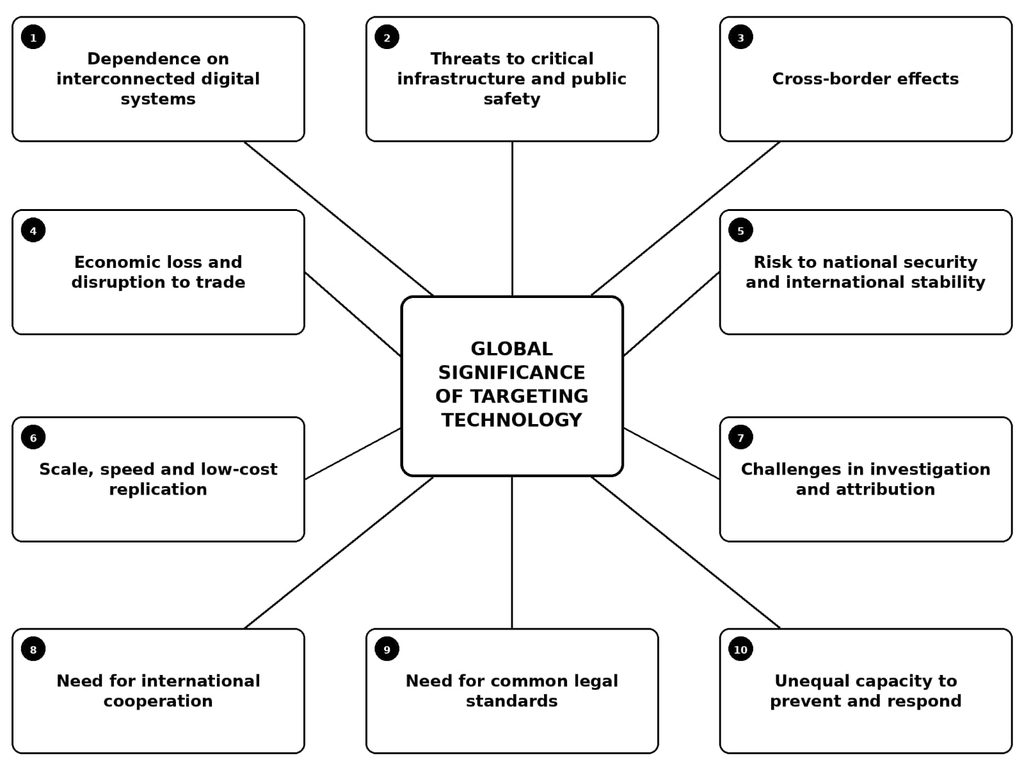
i. Dependence on interconnected digital systems:
Countries increasingly depend on connected information systems for essential services. A weakness in one system can affect organizations, users, or services elsewhere. For example, an attack on a service provider or widely used software may disrupt many organizations that depend on it. The risk is therefore not limited to the owner of the system directly attacked. It can affect customers, suppliers, public bodies and people who rely on the service.
ii. Threats to critical infrastructure and public safety:
Technology-targeting offences can endanger services on which public safety depends. If systems used by hospitals, power networks, transport services, financial institutions or government agencies are disabled or manipulated, the consequences may extend beyond financial loss to public health, safety and the continuity of government. Ransomware illustrates this risk: malicious software can encrypt data and interrupt the operation of public and private services. The United Nations has identified disruption to healthcare, education, finance, government functions and critical infrastructure as a serious international concern. The risk is also reflected in the World Economic Forum’s Global Cybersecurity Outlook 2026: 31% of survey respondents reported low confidence in their nation’s ability to respond to major cyber incidents, including attacks on critical infrastructure.
iii. Cross-border effects:
The internet allows offenders to operate from one country, use servers or services in another, and target systems in several more. The victim, the offender, the data and the infrastructure involved may all be located in different jurisdictions. This makes it difficult to identify where the offence was committed, which country should investigate it, and how evidence held abroad can be obtained. A national response alone may therefore be insufficient.
iv. Economic loss and disruption to trade:
Attacks on systems can cause direct financial loss through theft, ransom demands, recovery costs and damage to property. They can also interrupt business operations, delay transactions, expose confidential information and reduce public confidence in digital services. Because businesses increasingly depend on digital platforms and international supply chains, a serious attack can affect multiple companies and markets. The economic impact may continue after systems are restored, especially where customer or commercial data has been compromised. The financial cost can be substantial. IBM’s Cost of a Data Breach Report 2025 estimated the average global cost of a data breach at US$4.44 million. This figure concerns data breaches examined in the report; it is not an estimate of the average cost of every cybercrime or ransomware attack.
v. Risks to national security and international stability:
Technology-targeting attacks may be carried out by criminals, organised groups or other actors seeking to disrupt public institutions, obtain sensitive information or damage essential systems. When the target is critical infrastructure or a government network, the consequences may raise concerns about national security and relations between States. It may be difficult to determine who was responsible, particularly where offenders conceal their identities or route attacks through systems in other countries. This uncertainty can complicate investigation and increase the risk of misunderstanding between States.
vi. Scale, speed and low-cost replication:
Digital tools can be used to attack many systems rapidly. Malware may spread beyond its original target; stolen data can be copied repeatedly; and automated attacks can continue without the offender’s direct involvement at every stage. This makes technology-targeting offences capable of causing widespread harm in a short time. The cost of copying or redistributing digital material is also low, while the costs of detecting, containing and repairing an attack can be substantial.
vii. Challenges in investigation and attribution:
Technology-targeting offences often leave digital evidence such as system logs, account records, metadata and network traffic. That evidence may be held by private service providers or stored in another country, and it may disappear or be altered if not preserved quickly. Investigators may also face encryption, false identities, compromised devices and complex technical systems. Identifying the device or account used in an attack does not always establish who controlled it or intended the offence. These challenges make specialist expertise and timely cooperation important.
viii. Need for international cooperation:
Because offenders, targeted systems and electronic evidence may be located in different countries, effective investigation often requires States to work together. Cooperation may be needed to preserve electronic evidence, identify users, obtain records, locate suspects and coordinate investigations. The Council of Europe’s Budapest Convention criminalizes conduct such as illegal access and data or system interference, and provides procedural tools and a framework for cooperation on cybercrime and electronic evidence. The United Nations Convention against Cybercrime also provides for international cooperation against specified offences committed through ICT systems and for sharing electronic evidence relating to serious crimes. Together, these frameworks reflect the need for cross-border assistance in investigating technology-targeting offences.
ix. Need for common legal standards:
If national laws define technology-targeting offences very differently, offenders may exploit gaps between jurisdictions, and investigations may be delayed by differences in legal procedure. Common standards help countries criminalize core conduct consistently and support cooperation in evidence gathering and prosecution. At the same time, cybercrime laws must include appropriate safeguards. Investigatory powers should be used lawfully and proportionately, with respect for privacy, freedom of expression and other fundamental rights. The Budapest Convention expressly links effective criminal justice measures with human-rights and rule-of-law safeguards.
x. Unequal capacity to prevent and respond:
Countries differ in their cybersecurity resources, technical expertise, and ability to investigate complex attacks. Organizations with limited security measures may be more exposed, while some States may lack the capacity to preserve evidence or respond quickly. This makes capacity-building, information-sharing and cooperation important parts of the global response. Cybersecurity is not solely a technical matter: it also requires effective laws, trained investigators, reliable incident response and coordination between the public and private sectors.
4. Illustrative Global Case Studies:
i. Stuxnet and Iran’s Natanz Nuclear Facility:
Stuxnet was malicious software that targeted industrial control systems associated with Iran’s nuclear programme. It is widely reported to have targeted centrifuges at the Natanz enrichment facility, causing physical damage through digital means. The attack is commonly attributed to the United States and Israel, although responsibility has not been officially acknowledged. It illustrates how code targeting industrial technology can produce physical consequences and raise questions about national security and the application of international law.
ii. WannaCry Ransomware and the UK National Health Service:
In May 2017, the WannaCry ransomware spread internationally, encrypting data and disrupting computer systems. The U.S. Department of Justice reported that more than 230,000 computers in 150 countries were affected; the attack also significantly disrupted the UK National Health Service. A UK government report recorded more than 19,000 cancelled appointments. The incident demonstrates how malware can spread beyond its initial victims and interrupt essential public services.
iii. NotPetya and the Disruption of Global Business:
NotPetya appeared in 2017 and initially struck organizations in Ukraine, including those in the financial, energy, and government sectors. Its destructive effects spread internationally, disrupting businesses and services well beyond Ukraine. The U.S. Treasury reported billions of dollars in damage across Europe, Asia and the United States, including disruption to global shipping, trade and medicine production. The UK government attributed the attack to the Russian government, specifically its military. NotPetya shows how malware targeting systems in one country can cause widespread losses across connected businesses and supply chains.
iv. Cyberattacks on Ukraine’s Electricity Grid:
In December 2015, attackers accessed the networks of three Ukrainian electricity distribution companies and remotely operated equipment to cause power outages. The U.S. Department of Energy reports that approximately 225,000 people lost electricity. This incident is significant because it demonstrated that a cyberattack could manipulate operational technology and directly disrupt the delivery of electricity.
v. Colonial Pipeline Ransomware Attack:
The ransomware attack on the company’s IT network led the operator to shut down its pipeline system temporarily. The U.S. Department of Energy coordinated with government, industry and state partners to respond and help move fuel to affected areas. It demonstrates how an attack on computer systems can disrupt a physical service essential to the public.
5. Legal Recognition in Pakistan:
Pakistan’s Prevention of Electronic Crimes Act, 2016 (PECA) criminalizes several offences directed at systems and data. Sections 3 to 5 address unauthorized access, unauthorized copying or transmission of data, and interference with or damage to an information system or data. Sections 6 to 8 provide corresponding offences involving critical-infrastructure systems and data. Section 23 addresses malicious code intended to cause harm to an information system or data. These provisions reflect the importance of protecting both ordinary systems and systems whose disruption could have wider consequences. The global significance of these offences is also recognized internationally: the Budapest Convention provides a framework for criminalizing attacks against computer systems and for cooperation in cybercrime investigations.
6. Conclusion:
Targeting technology has global significance because computer systems and data support services that cross borders and affect everyday life. An attack on one system may disrupt businesses, public services, critical infrastructure and people in several countries. Its speed, reach and technical complexity make prevention and investigation difficult for any one State acting alone. Effective protection therefore requires secure systems, clear criminal laws, skilled investigators and timely international cooperation, together with safeguards that preserve fundamental rights. Technology-targeting offences are not merely attacks on machines: where societies depend on digital systems, they can become attacks on the continuity of essential services and the security of the public.