
1. Introduction:
Environmental policies represent the State’s response to the changing relationship between human development and the environment. In Pakistan, the evolution of environmental policies has been gradual, shaped by growing environmental degradation, development needs, international commitments, and increasing recognition of the importance of sustainable development. From an early emphasis on the conservation of natural resources, Pakistan progressively moved towards broader environmental regulation, pollution control, sustainable development and climate action. The National Conservation Strategy, 1992 is generally regarded as a landmark in this development, followed by the Pakistan Environmental Protection Act, 1997 and the National Environmental Policy, 2005, which provided increasingly comprehensive frameworks for environmental governance.
2. Etymology and Meaning of the Term “Environment”:
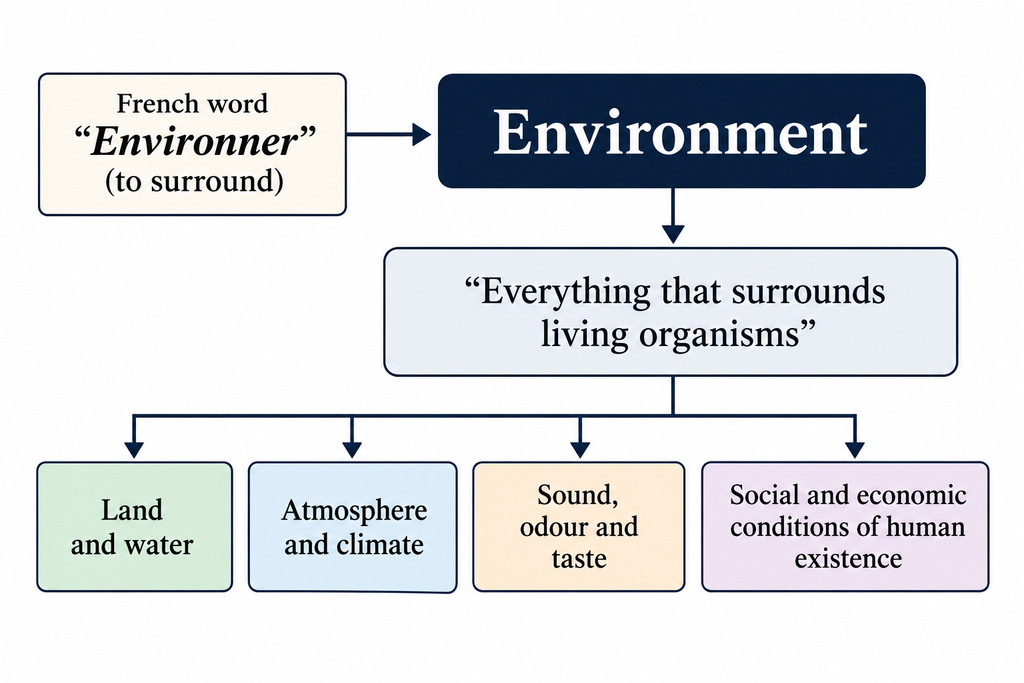
According to Blacks Law Dictionary:
“The totality of physical, economic, cultural, aesthetic and social circumstances and factors which surround and affect the desirability and value of property and which also affect the quality of people’s lives.”
3. Definition of Environment
Under Section 2(x) of the Pakistan Environmental Protection Act, 1997, “environment” means:
- i. air, water and land;
- ii. all layers of the atmosphere;
- iii. all organic and inorganic matter and living organisms;
- iv. the ecosystem and ecological relationships;
- v. buildings, structures, roads, facilities and works;
- vi. all social and economic conditions affecting community life; and
- vii. The inter-relationships between any of the factors specified in sub-clauses (i) to (vi).
4. Importance of Environmental Protection
Environmental protection is essential for the survival, health and sustainable development of human society. A healthy environment provides the basic conditions necessary for human well-being and economic and social development. Its importance may be understood as follows:
- Protection of Human Health
- Conservation of Natural Resources
- Sustainable Economic Development
- Protection of Biodiversity and Ecosystems
- Climate Change Resilience
- Intergenerational Equity
- Constitutional and Legal Significance
5. Evolution of Environmental Policies in Pakistan
The evolution of environmental policies reflects Pakistan’s continuing effort to reconcile economic development with environmental protection while responding to emerging environmental challenges such as climate change, loss of biodiversity, water scarcity and pollution. This evolution has been gradual, moving from sector-specific regulation and conservation towards comprehensive environmental governance, sustainable development, climate resilience and constitutional recognition of environmental rights.
i. Early Environmental Regulation and Conservation:
In the early years of Pakistan, environmental protection was not treated as a separate and comprehensive field of law. Environmental concerns were addressed through laws dealing with specific sectors such as forests, wildlife, water, agriculture, land and public health. The principal emphasis was on the conservation and management of natural resources rather than on environmental protection as an integrated concept. This sectoral approach provided the initial legal foundation for environmental management in Pakistan.
ii. Emergence of Environmental Institutions in the 1970s:
The 1970s marked the beginning of a more organized approach towards environmental protection. The 1972 Stockholm Conference on the Human Environment was an important international catalyst, encouraging States to establish institutions for environmental management. Pakistan consequently began developing specialized administrative mechanisms for pollution control. In Punjab, the Environmental Pollution Control Organization (EPCO) was established in 1975. This period marked the transition from scattered sectoral regulation towards institutional environmental administration.
iii. Constitutional Framework under the Constitution of 1973:
The Constitution of 1973 originally contained no express fundamental right to a clean and healthy environment. However, environmental protection gradually acquired constitutional significance through the interpretation of existing fundamental rights, particularly Article 9, guaranteeing the right to life. In Shehla Zia v. WAPDA (PLD 1994 SC 693), the Supreme Court significantly expanded the understanding of the right to life. The Court recognized that environmental hazards could affect the life and well-being protected by the Constitution. The judgment provided an important foundation for Pakistan’s constitutional environmental jurisprudence.
iv. Pakistan Environmental Protection Ordinance, 1983:
The Pakistan Environmental Protection Ordinance, 1983 represented an important legislative milestone in the development of environmental law. It introduced a more comprehensive legal framework for environmental protection and pollution control and strengthened the institutional basis for environmental administration. The Ordinance represented a shift from purely sectoral regulation towards an integrated approach to environmental protection. It was eventually replaced by the Pakistan Environmental Protection Act, 1997.
v. National Conservation Strategy, 1992:
The National Conservation Strategy (NCS), 1992 marked a major development in Pakistan’s environmental policy. The NCS broadened the environmental agenda beyond pollution control and emphasized the relationship between economic development, conservation and the sustainable use of natural resources. It sought to incorporate environmental considerations into development planning and promoted the concept of sustainable development. The NCS therefore represented a transition from conventional resource conservation towards integrated environmental and development planning.
vi. Pakistan Environmental Protection Act, 1997:
The enactment of the Pakistan Environmental Protection Act, 1997 (Act XXXIV of 1997) was one of the most significant milestones in Pakistan’s environmental law history. The Act established a comprehensive statutory framework for:
- protection, conservation and improvement of the environment;
- prevention and control of pollution;
- environmental standards;
- environmental assessment;
- hazardous substances;
- environmental enforcement; and
- environmental adjudication.
An important feature of the Act was Section 12, which established the legal framework for Initial Environmental Examination (IEE) and Environmental Impact Assessment (EIA). The Act transformed environmental protection from a relatively fragmented administrative function into a comprehensive statutory regulatory regime.
vii. National Environmental Action Plan, 2001:
The National Environmental Action Plan (NEAP), 2001 shifted attention from the creation of environmental laws towards their implementation and effective environmental management. It emphasized institutional coordination, capacity building and practical measures for improving environmental conditions. The NEAP therefore represented an effort to strengthen the implementation of environmental policy and institutional capacity.
viii. National Environmental Policy, 2005:
The National Environmental Policy, 2005 (NEP) provided a broad national framework for environmental protection and sustainable development. It sought to integrate environmental considerations into economic and development planning and addressed areas including:
- pollution control;
- air and water quality;
- natural resource management;
- biodiversity;
- public health; and
- sustainable development.
The policy reflected a movement towards mainstreaming environmental considerations across different sectors of national development.
ix. Judicial Development of Environmental Protection:
The judiciary has played an important role in strengthening environmental protection in Pakistan. Following Shehla Zia v. WAPDA, Pakistani courts increasingly recognized that environmental degradation and pollution could have implications for fundamental rights. Environmental litigation consequently became an important mechanism for addressing environmental hazards, pollution and governmental inaction. Judicial intervention therefore complemented legislative development and contributed to the emergence of a rights-based approach to environmental protection.
x. 18th Constitutional Amendment and Devolution, 2010:
The 18th Constitutional Amendment, 2010 fundamentally altered the institutional structure of environmental governance in Pakistan. The Amendment abolished the Concurrent Legislative List, resulting in substantial devolution of legislative authority to the provinces. Environmental pollution and ecology consequently became primarily matters within the provincial sphere. The existing federal environmental framework continued during the transitional period, while the provinces subsequently developed their own environmental legislation. The 18th Amendment therefore transformed environmental governance from a predominantly federal model into a substantially devolved provincial system.
xi. Provincial Environmental Legislation:
Following the 18th Amendment, the provinces developed their own environmental regulatory frameworks. Major provincial developments included:
- Balochistan Environmental Protection Act, 2012
- Punjab Environmental Protection (Amendment) Act
- Sindh Environmental Protection Act, 2014
- Khyber Pakhtunkhwa Environmental Protection Act, 2014
These laws strengthened provincial responsibility for pollution control, environmental assessment, environmental standards and enforcement. Consequently, Pakistan’s environmental governance became increasingly provincialized, while national coordination and international environmental responsibilities continued to operate at the federal level.
xii. Expansion into Climate Change and Sectoral Environmental Policies:
Environmental policies subsequently expanded beyond traditional pollution control and natural-resource conservation. Pakistan introduced policies addressing climate change, forests, water, sanitation, waste, air pollution and environmentally sustainable transport. Important developments included:
- National Drinking Water Policy, 2009
- National Climate Change Policy, 2012
- National Sanitation Policy
- National Forest Policy, 2015
- National Rangeland Policy
- National Electric Vehicle Policy
- Updated National Climate Change Policy, 2021
- Updated Nationally Determined Contributions (NDCs), 2021
- National Hazardous Waste Management Policy, 2022
- National Clean Air Policy, 2023
- National Adaptation Plan, 2023
These developments demonstrate the transformation of environmental policy into a cross sectoral framework covering climate, forests, waste, air, water, transport and adaptation.
xiii. International Environmental Commitments and Climate Governance:
Pakistan’s environmental policies have also been influenced by its participation in international environmental agreements relating to matters such as climate change, biodiversity and wetlands. Climate change has assumed particular importance because Pakistan is highly vulnerable to climate related hazards. Consequently, national policies have increasingly focused on climate adaptation, mitigation and resilience. The Updated National Climate Change Policy, 2021, Pakistan’s Updated NDCs, 2021, and the National Adaptation Plan, 2023 demonstrate this growing emphasis on climate governance.
xiv. Constitutional Recognition of Environmental Rights, 2024:
A major recent development was the Constitution (Twenty-sixth Amendment) Act, 2024, which inserted Article 9A into the Constitution of Pakistan. Article 9A provides:
“Every person shall be entitled to a clean, healthy and sustainable environment.”
This represents a major constitutional development because environmental protection, previously developed largely through legislation and judicial interpretation, now has an express constitutional foundation. Article 9A strengthens the rights-based character of Pakistan’s environmental law and builds upon the development of environmental protection under Article 9.
xv. Present Position: From Pollution Control to Environmental Governance:
The present environmental policy framework of Pakistan is considerably broader than the earlier sectoral approach. It now combines:
- constitutional environmental rights;
- federal and provincial environmental legislation;
- environmental institutions;
- environmental standards and pollution control;
- IEE and EIA mechanisms;
- environmental adjudication and judicial review;
- natural-resource conservation;
- sustainable development;
- climate-change mitigation and adaptation; and
- international environmental commitments.
Environmental governance has therefore developed into a multidimensional field, involving constitutional law, administrative law, public health, natural-resource management, climate policy and international environmental law.
6. Conclusion:
The evolution of environmental policies in Pakistan demonstrates a gradual transition from scattered sector specific conservation measures to a comprehensive system of environmental governance. Beginning with the regulation and conservation of natural resources, Pakistan progressively developed environmental institutions, statutory frameworks, national policies, judicial principles and climate governance mechanisms. The Pakistan Environmental Protection Ordinance, 1983, the National Conservation Strategy, 1992, the Pakistan Environmental Protection Act, 1997, the National Environmental Policy, 2005, the devolution of environmental governance after the 18th Amendment, and subsequent climate and sectoral policies represent major stages in this evolution.