
1. Introduction:
Negotiable instruments constitute a fundamental pillar of commercial and banking transactions. They provide a legally recognized mechanism through which money can be transferred without the physical movement of cash, thereby ensuring convenience, certainty and efficiency in financial dealings. Owing to their negotiability and legal enforceability; they facilitate the smooth conduct of trade and commerce while promoting confidence among parties. The Negotiable Instruments Act 1881 governs the law relating to negotiable instruments and primarily regulates three principal instruments: Promissory Notes, Bill of Exchange, and Cheque. These instruments facilitate credit transactions, reduce the risks associated with carrying cash, and provide a secure and reliable method of payment in both personal and commercial dealings.
As aptly observed by James Matlock Ogden:
“It would be impossible to transact business of any magnitude today if cash payments were required. We see the truth of this when we consider that more than 90% of all commercial transactions are estimated to be carried on today by the medium of commercial paper or negotiable instruments.”
2. Meanings of the term Negotiable Instrument:
According to Merriam Webster Dictionary of law:
“A transferable instrument (as a note, check, or draft) containing an unconditional promise or order to pay to a holder or to the order of a holder upon issue, possession, demand, or at a specified time.”
According to the Cambridge Business English Dictionary:
“A written order or promise to pay a fixed amount of money on demand or at a particular time, for example, a cheque or banknote.”
3. DEFINITIONS:
Statutory Definition:
Under section 13 of Negotiable Instruments Act, 1881:
“A negotiable instrument means a Promissory Note, Bill of Exchange or Cheque payable either, to order or to bearer…”
4. Essentials of a Negotiable Instrument:
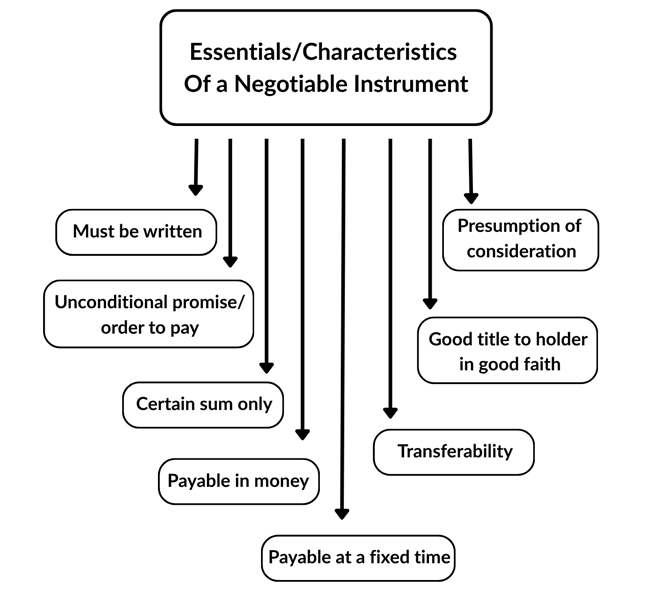
Some of the essentials and fundamental characteristics of negotiable instruments are as follows:
i. Must be written:
A negotiable instrument must always be in written form. It may be handwritten, typed, or printed, but it cannot be oral or verbal. This requirement exists because written documents provide permanence, clarity, and serve as reliable evidence in case of any dispute or legal proceedings.
For Example:
If A tells B, “I will pay you Rs. 5000 tomorrow,” this does not constitute a valid negotiable instrument, as it is merely a verbal promise.
However, if A writes this promise down, signs the document, and delivers it to B, it may constitute a valid negotiable instrument, provided the other legal requirements are fulfilled.
ii. Unconditional Promise or Order to Pay:
A negotiable instrument must contain an unconditional promise or order to pay. This means that no conditions, qualifications, or uncertain future events should be attached to the instrument.
For Example:
- If a negotiable instrument states, “Pay Rs. 5000/- to Mr. A,” it is valid.
- However, if it includes a condition such as “Pay if Mr. C wins a lottery” or “Pay if it rains tomorrow,” it becomes invalid.
iii. Certain Sum of Money Only:
The amount of money to be paid must be certain and fixed. This means that the sum should be clearly specified and not subject to any change or ambiguity.
- It must be clearly written in numbers or words.
- It must not be changeable or confusing.
For Example:
- “Pay Rs. 25,000 to Mr. X” is a valid negotiable instrument.
- Whereas, “Pay whatever amount is fair to Mr. X” is invalid due to uncertainty.
iv. Payable in Money Only:
A negotiable instrument must contain a promise or order to pay only in legal currency, such as PKR, dollars, etc. It cannot include:
- Goods
- Services
- Property
- Anything other than money
For Example:
- “Pay Rs. 25,000 to Mr. X” is a valid negotiable instrument.
- Whereas, “Deliver a car to Mr. X” is not valid as it involves something other than money.
vi. Certainty as to Time of Payment:
A negotiable instrument must specify a definite time for payment or clearly state that it is payable on demand. A Promissory Note or Bill of Exchange may be payable on demand or at a fixed or determinable future time, whereas a Cheque is always payable on demand. The time of payment should not be vague or uncertain.
- It must be fixed
- It must be clear
- It must be easily understandable to all parties
An instrument payable “on demand” is also regarded as valid, as it implies payment whenever demanded by the holder.
For Example:
- “Pay Rs. 25,000 to Mr. X on 10th July 2026” is a valid negotiable instrument.
- Whereas, “Pay Rs. 25,000 to Mr. X whenever you feel like it” is invalid due to uncertainty.
vi. Must Be Transferable:
A negotiable instrument must be capable of being freely transferred from one person to another so that it can circulate easily like money. The person to whom it is transferred becomes the new legal owner (holder) and is entitled to receive the payment. This free transferability is an essential feature of negotiable instruments, allowing them to pass smoothly from one person to another in the ordinary course of business. The instrument can be transferred:
- By delivery (simply handing it over, as in the case of bearer cheques)
- By endorsement and delivery
For Example:
If A gives a Cheque to B, and B endorses (signs) it and transfers it to C, then C becomes the holder and can go to the bank to receive the money.
vii. Holder in Due Course:
Under Section 9 of the Negotiable Instruments Act, 1881, a holder in due course is a person who acquires a negotiable instrument for consideration, before it becomes payable, and without sufficient cause to believe that any defect exists in the title of the person from whom it is obtained. Such a holder enjoys special protection under the law and may acquire a good title to the instrument even where the title of the previous holder was defective, provided the statutory requirements of a holder in due course are satisfied.
For Example:
A obtains a cheque through fraud and transfers it to B for value before it becomes payable. If B receives the cheque honestly and without knowledge of the fraud or defect in A’s title, B may qualify as a holder in due course and acquire a good title to the cheque.
viii. Presumption of Consideration:
Under Section 118(a) of the Negotiable Instruments Act, 1881, every negotiable instrument is presumed to have been made or drawn for consideration, until the contrary is proved. In other words, the law initially presumes that something of value, such as goods, services or a loan, was given in return for the instrument. This presumption is rebuttable, meaning that evidence may be produced to prove the contrary.
For Example:
If someone gives you a Promissory Note for Rs. 10,000, the court will presume that you have given something in return, such as goods, a loan, or services, unless the contrary is proved.
5. Types of Negotiable Instruments:
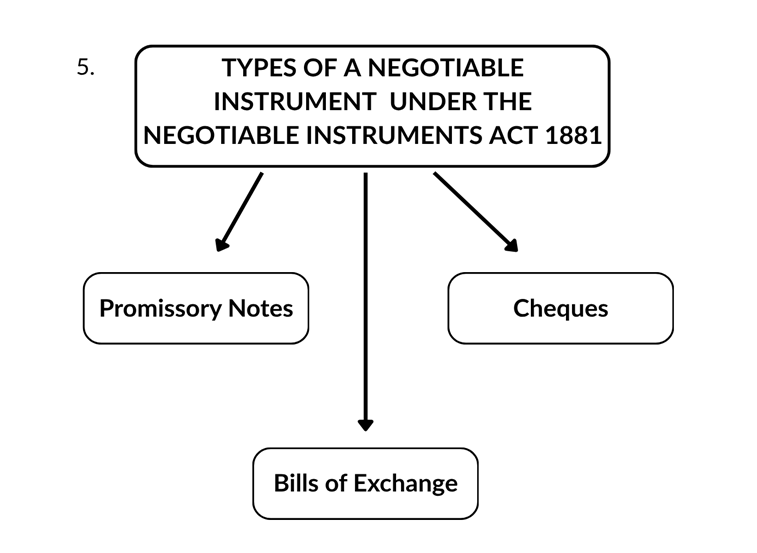
Under the Negotiable Instruments Act, 1881, negotiable instruments are classified into three main types, each of which is explained below:
i. Promissory Note:
Under Section 4 of the Negotiable Instruments Act, 1881, a Promissory Note is a written and signed instrument in which one person makes an unconditional undertaking, signed by the maker, to pay a certain sum of money to, or to the order of, a certain person.
a. Parties Involved:
- Maker: The person who makes the promise and undertakes to pay the amount.
- Payee: The person to whom the payment is to be made.
b. Illustration:
Ahmad writes, “I promise to pay Rs. 15,000 to Saeed on 30th June 2025.” This is a Promissory Note.
c. Essential Elements:
- It must be in writing
- It must contain a clear and unconditional promise to pay
- It must be signed by the maker
- The amount must be certain
- The parties must be clearly identified
- The time of payment must be certain or payable on demand
d. Practical Uses:
Promissory Notes are commonly used in loan agreements, where one party borrows money and gives a written promise to repay it within a specified time.
ii. Bill of Exchange:
Under Section 5 of the Negotiable Instruments Act, 1881, a Bill of Exchange is a written instrument containing an unconditional order, signed by the maker, directing a certain person to pay a certain sum of money to, or to the order of, a certain person.
a. Parties Involved:
- Drawer: The person who makes the bill and gives the order to pay.
- Drawee: The person who is directed to pay the money.
- Payee: The person to whom the money is payable.
b. Illustration:
Ali (the drawer) orders Bilal (the drawee) to pay Rs. 20,000 to Mr. Z (the payee) on 1st August 2026. This is a Bill of Exchange.
c. Essential Elements:
- It must be in writing
- It must be signed by the drawer
- It must contain a clear and unconditional order to pay
- The drawee must accept the bill before it becomes effective
- The amount must be certain
- The parties (drawer, drawee, and payee) must be clearly identified
- The time of payment must be certain or payable on demand
d. Practical Uses:
Bills of Exchange are commonly used in business transactions between buyers and sellers, especially where goods are sold on credit, allowing the buyer to pay at a later date.
iii. Cheques:
Under Section 6 of the Negotiable Instruments Act, 1881, a Cheque is a Bill of Exchange drawn on a specified banker and is payable on demand. It constitutes a written order by the account holder directing the bank to pay a specified sum of money to a designated person or to the bearer of the instrument.
a. Parties to a Cheque:
- Drawer: The person who draws (writes) the Cheque and is typically the account holder.
- Drawee: The bank upon which the Cheque is drawn and which is directed to make the payment.
- Payee: The person in whose favour the Cheque is issued and who is entitled to receive the payment.
b. Illustration:
Mr. A issues a Cheque for Rs. 5,000 in favour of Mr. B. Mr. B presents the Cheque to the bank, and upon due verification, the bank makes the payment to him.
c. Essential Elements:
For a Cheque to be legally valid, it must satisfy the following requirements:
- It must be in writing.
- It must contain an unconditional order to pay.
- It must be drawn on a specified bank.
- It must be signed by the drawer.
- It must be payable on demand only.
- It must specify a certain sum of money.
- It must clearly mention the name of the payee (except in bearer cheques).
- It should include the date of issue.
d. Practical Uses:
A Cheque is commonly used as a secure and reliable mode of payment in both personal and commercial dealings. It facilitates the payment of salaries, settlement of business transactions, and discharge of various financial obligations such as bills and dues. In personal finance, it provides a written record of transactions, ensuring accountability and ease of verification.
6. Other Types of Negotiable Instruments:
Under the law, there are certain other instruments which have acquired negotiability by custom and usage. These include:
- Bank drafts
- Pay orders
- Treasury bills
- Dividend warrants
- Traveller’s cheques
- Bearer bonds
7. Conclusion:
The Negotiable Instruments Act, 1881 facilitates the use of secure and efficient methods of payment in both personal and commercial transactions. By employing instruments such as Promissory Notes, Bills of Exchange, and Cheques, individuals and businesses can avoid the risks associated with carrying cash while ensuring that their transactions are properly documented and legally enforceable. Negotiable instruments are widely valued for their simplicity, legal recognition, reliability, and transferability, making them indispensable in modern financial dealings.
As observed by the U.S. Securities and Exchange Commission:
“Negotiable instruments are essential to the modern economy because they facilitate the transfer of funds and the extension of credit.”