
1. Introduction:
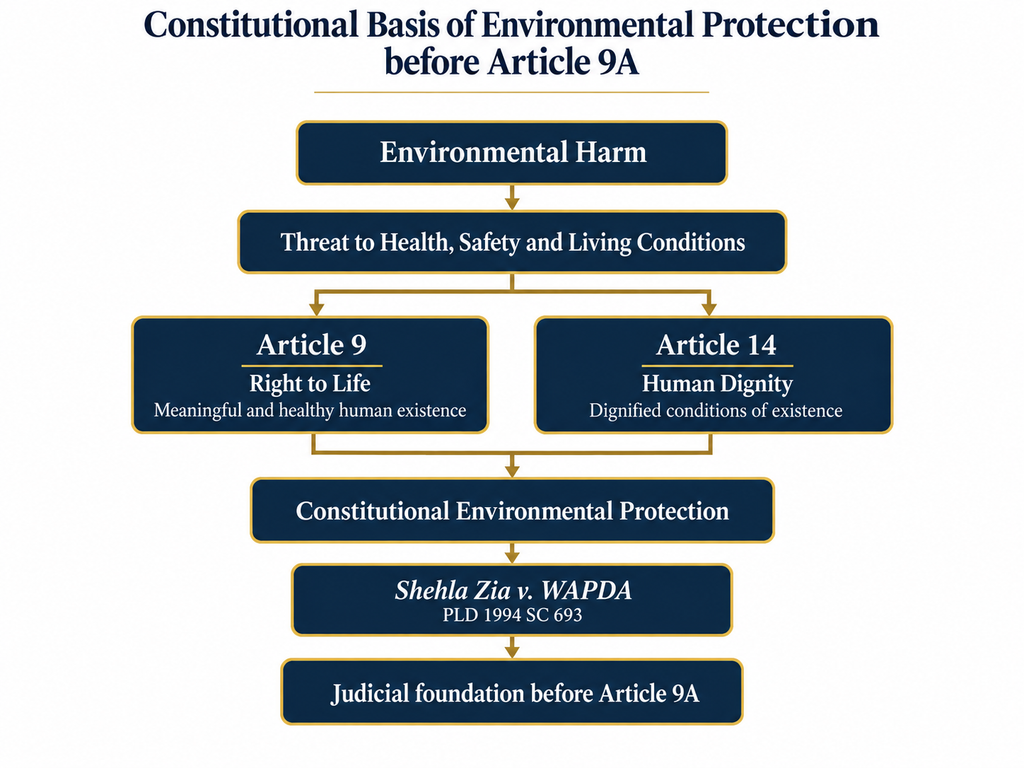
Before the insertion of Article 9A, the Constitution of Pakistan did not expressly guarantee a fundamental right to a clean and healthy environment; instead, environmental protection was developed through judicial interpretation of existing fundamental rights, particularly Article 9, which protects life and liberty, and Article 14, which guarantees human dignity. In Shehla Zia v. WAPDA, PLD 1994 SC 693, the Supreme Court gave the word “life” in Article 9 a broad meaning and held that it includes the conditions and amenities necessary for meaningful and dignified human existence. Thus, before Article 9A, Articles 9 and 14 together provided the constitutional foundation for environmental protection by safeguarding meaningful life, health, safety and human dignity.
2. Constitutional Position before Article 9A:
Before the insertion of Article 9A, the Constitution of Pakistan contained no specific provision expressly recognizing environmental protection as an independent fundamental right. Therefore, environmental concerns were brought within the scope of existing constitutional guarantees, especially Articles 9 and 14. The superior courts treated serious environmental harm as a constitutional issue where it affected life, health, safety or human dignity. In this way, environmental protection acquired constitutional significance through the interpretation of fundamental rights even before it was expressly recognized in the Constitution.
3. Right to Life and Liberty (Article 9):
Article 9 provides that “No person shall be deprived of life or liberty save in accordance with law.” Although the provision appears primarily to protect against unlawful deprivation of life or liberty, the superior courts did not confine the word “life” to mere physical or biological existence. In the context of environmental protection, Article 9 was interpreted broadly so that the right to life extended to those conditions, facilities and amenities necessary for a person to live a meaningful, healthy and dignified life. This wider interpretation enabled serious environmental hazards affecting human health and safety to fall within the constitutional protection of Article 9.
4. Meaning of “Life” under Article 9:
In Shehla Zia v. WAPDA, PLD 1994 SC 693, the Supreme Court made it clear that the word “life” cannot be confined to mere physical or vegetative existence. The Court recognized that life includes the various facets of human existence together with the amenities and facilities necessary for a person to enjoy life with dignity. Thus, for constitutional purposes, life means more than mere survival; it includes meaningful, healthy and dignified human existence. This broader interpretation provided the constitutional basis for extending Article 9 to serious environmental hazards affecting human health and well being.
5. Environmental Protection under Article 9:
The environmental dimension of Article 9 developed from the recognition that environmental conditions directly affect human health and safety. Pollution, hazardous installations and other environmental risks may expose individuals to disease, injury or conditions incompatible with meaningful human life. Since the constitutional guarantee of life includes the conditions necessary for healthy and dignified existence, serious environmental harm could therefore fall within the protection of Article 9. In this way, the right to life became a constitutional basis for protecting individuals against environmental hazards.
6. Inviolability of Human Dignity (Article 14):
Article 14(1) provides that “The dignity of man and, subject to law, the privacy of home, shall be inviolable.” In the context of environmental protection, human dignity was understood as extending beyond protection against humiliation or physical mistreatment. It also concerned the conditions in which a person is able to live with health, safety, and basic human well-being. Therefore, serious environmental degradation could engage Article 14, where unhealthy or unsafe conditions undermine the dignity of human existence.
7. Environmental Protection and Human Dignity:
The connection between Article 14 and environmental protection was clearly recognized in Shehla Zia v. WAPDA, where the Supreme Court considered Articles 9 and 14 together. The Court examined whether a person could genuinely enjoy human dignity if compelled to live without basic conditions necessary for health and well-being, including a clean atmosphere and an unpolluted environment. The principle was that human dignity cannot be meaningfully enjoyed where environmental conditions seriously threaten health, safety or basic human welfare. Thus, Article 14 strengthened the environmental protection available under Article 9.
8. Relationship between Articles 9 and 14:
Articles 9 and 14 operated together in providing constitutional protection against environmental harm. Article 9 protected life and the conditions necessary for meaningful human existence, while Article 14 protected human dignity and the conditions necessary for dignified existence. Environmental degradation could affect both rights at the same time by threatening health, safety, quality of life and basic human well-being. Therefore, before Article 9A, the combined interpretation of Articles 9 and 14 enabled the courts to treat serious environmental harm as a matter involving fundamental constitutional rights.
9. Landmark Case: Shehla Zia v. WAPDA
Shehla Zia and others v. WAPDA, PLD 1994 SC 693 is the leading case linking environmental protection with Articles 9 and 14. The dispute concerned a proposed high voltage grid station in a residential area and the possible health effects of electromagnetic fields. The Supreme Court interpreted “life” under Article 9 broadly, holding that it encompasses the conditions and amenities necessary for a meaningful and dignified human existence, and linked this protection to human dignity under Article 14. The Court also adopted a precautionary approach, recognizing that scientific uncertainty should not prevent protective action where a potentially serious threat to health exists. The case therefore established that environmental hazards could fall within the protection of fundamental rights even before Article 9A.
10. Article 9 and Water Pollution:
The broad interpretation of Article 9 was further applied to environmental harm caused by water pollution. In General Secretary, West Pakistan Salt Miners Labour Union (CBA), Khewra v. Director, Industries and Mineral Development, Punjab, 1994 SCMR 2061, mining activities threatened contamination of a water source used by residents and mine workers. The Supreme Court treated access to water free from pollution and contamination as an essential component of the right to life, recognizing that human survival and health depend upon access to safe water. The case therefore confirmed that protection of clean water could fall within the constitutional guarantee of life under Article 9.
11. Judicial Development of Environmental Protection:
Before Article 9A, the constitutional protection of the environment was developed primarily through judicial interpretation of Articles 9 and 14. The courts expanded the meaning of life and human dignity so that serious environmental harm affecting health, safety and basic living conditions could fall within the protection of fundamental rights. This judicial development laid the constitutional foundation for environmental protection in Pakistan before the express recognition of the right to a clean, healthy and sustainable environment under Article 9A.
12. Conclusion:
Articles 9 and 14 provided the constitutional basis for environmental protection in Pakistan through the broad interpretation of the right to life and human dignity. Through Shehla Zia v. WAPDA and the application of Article 9 to water pollution, the courts recognised that life includes the conditions necessary for health, safety and dignified human existence. Thus, Articles 9 and 14 together laid the constitutional foundation for environmental protection before Article 9A expressly recognised the right to a clean, healthy and sustainable environment.